Care basicsTM-14
Tropical Fish Water Temperature: Chart for 23 Species, Setting It for Tank Mates, Heater Wattage, Summer Heat, Winter, Power Outages and How Goldfish and Medaka Differ
About 25°C is the usual guide for tropical fish, but each species has its own suitable range. With tank mates, match the range where all of them overlap.

In this article (17 sections)
- In short: what water temperature is best for tropical fish?
- How do you set the water temperature for tank mates?
- How warm is too warm for tropical fish?
- Can tropical fish live at 20°C?
- What wattage heater keeps tropical fish water warm?
- How do you install a tropical fish heater safely?
- Where should you put the aquarium thermometer?
- How do you lower tropical fish water temperature in summer?
- How do you keep tropical fish water warm in winter?
- What if the water cools because of a power outage or heater failure?
- How do goldfish and medaka differ from tropical fish in water temperature?
- How do you match the water temperature when adding tropical fish?
- What are common mistakes with tropical fish water temperature?
- What terms come up when talking about water temperature?
- What else should you know along with water temperature?
What are common questions about tropical fish water temperature?5
- Sources
In short: what water temperature is best for tropical fish?
About 25°C is the usual guide for tropical fish water temperature. But each fish has its own suitable range, so in a community tank, match the range where all of them overlap.
A manufacturer's guide gives 25 to 26°C as the suitable temperature for tropical fish. In shops and in books, this is usually the first number you see.
The trouble is that the upper and lower limits differ from fish to fish. This site puts the suitable ranges from the care data for 23 species into a table.
What this article covers:
- Suitable ranges for 23 species, and how to set the temperature for tank mates
- What happens when the water is too warm or too cold
- Heater wattage by water volume, and how to install a heater safely
- How to cool the water in summer, and what to do in winter and during power outages
- How goldfish and medaka differ
| Species | Temperature (°C) | Swimming level |
|---|---|---|
| Neon tetra | 21–25 | Middle |
| Cardinal tetra | 23–29 | Middle |
| Rummy-nose tetra | 23–26 | Middle |
| Guppy | 17–28 | Top |
| Platy | 20–26 | Top |
| Betta (male) | 22–30 | |
| Angelfish | 24–30 | |
| Panda cory | 22–25 | Bottom |
| Peppered cory | 22–26 | Bottom |
| Otocinclus | 21–26 | Bottom |
| Harlequin rasbora | 21–28 | Middle |
| Zebra danio | 18–25 | Middle |
| Cherry barb | 20–27 | Middle |
| Tiger barb | 20–26 | Middle |
| Dwarf gourami | 22–27 | Middle |
| Kuhli loach | 21–26 | Bottom |
| Bristlenose pleco | 21–26 | Bottom |
| Medaka | 16–22 | Top |
| Goldfish | 20–24 | Middle |
| Japanese swamp shrimp | 23–28 | Bottom |
| Cherry shrimp | 16–28 | Bottom |
| Amano shrimp | 20–28 | Bottom |
| Nerite snail | 10–28 |
Source (23)
- Seriously Fish (Paracheirodon innesi)
- Seriously Fish (Paracheirodon axelrodi)
- Seriously Fish (Hemigrammus bleheri)
- Seriously Fish (Poecilia reticulata)
- Seriously Fish (Xiphophorus maculatus)
- Seriously Fish (Betta splendens)
- Seriously Fish (Pterophyllum scalare)
- Seriously Fish (Corydoras panda)
- Seriously Fish (Corydoras paleatus)
- Seriously Fish (Otocinclus macrospilus)
- Seriously Fish (Trigonostigma heteromorpha)
- Seriously Fish (Danio rerio)
- Seriously Fish (Puntius titteya)
- Seriously Fish (Puntigrus tetrazona)
- Seriously Fish (Trichogaster lalius)
- Seriously Fish (Pangio semicincta)
- Seriously Fish (Ancistrus cf. cirrhosus)
- Seriously Fish (Oryzias latipes)
- RSPCA Australia: How should I care for my goldfish?
- GEX (temperature), Tokyo Aqua Garden (pH, level, temperament), Kyoto Prefecture Red Data Book 2015 (size)
- Aquarium Co-Op (temperature, pH), UF/IFAS EDIS IN1301 (size, habitat)
- GEX (temperature), Tokyo Aqua Garden (pH, level), Hyogo Prefecture Red Data Book (size)
- Tokyo Aqua Garden (temperature, pH, temperament), Ishikawa Prefecture Red Data Book (size)
Grouping the table above by how to think about water temperature gives this.
| Group | Fish that fit (from the table) | What to watch with temperature |
|---|---|---|
| Tropical fish with a fairly low upper limit | Neon tetra, panda corydoras, zebra danio | High temperatures in summer |
| Tropical fish with a fairly high upper limit | Cardinal tetra, betta, angelfish, guppy, harlequin rasbora | Keeping the water warm in winter |
| Fish that need no heater | Goldfish, medaka | Do not keep them in the same tank as tropical fish |
| Shrimp and snails | Neocaridina shrimp, red cherry shrimp, Amano shrimp, nerite snail | High summer temperatures and oxygen |
The key point: think of tropical fish water temperature as a range, not one number, and you will make fewer tank mate mistakes.
How do you set the water temperature for tank mates?
Set a community tank to where all the fish's suitable ranges overlap. That is between the highest lower limit and the lowest upper limit.
For example, neon tetras and cardinal tetras are both small fish that swim in the middle of the tank. Yet their suitable ranges differ a little.
| Species | Temperature (°C) | Swimming level |
|---|---|---|
| Neon tetra | 21–25 | Middle |
| Cardinal tetra | 23–29 | Middle |
| Panda cory | 22–25 | Bottom |
| Otocinclus | 21–26 | Bottom |
Source (4)
As the table shows, the cardinal tetra's range is higher and the panda corydoras's range is lower. The four species overlap only in a narrow band in the middle.
Here are the steps for setting the water temperature.
- List every fish you keep in the table
- Find the highest lower limit
- Find the lowest upper limit
- Set the heater between the two
- If there is no overlap, rethink the combination
The narrower the overlap, the more often you should check the thermometer. In summer and winter, the water easily drifts outside the range.
Tropical fish water temperature is decided when you choose tank mates. To see compatibility and temperature together, the Tropical Fish Tank Mates Chart is handy.
How warm is too warm for tropical fish?
The upper end of each range in the table is the guide. A manufacturer's guide says tropical fish do not cope well with water above 30°C.
Though they come from the tropics, tropical fish are not especially tolerant of warm water. Tropical rivers change very little in temperature through the year.
When the water gets too warm for tropical fish, this happens.
| What happens | Why | Source |
|---|---|---|
| Oxygen runs short | Warmer water holds less dissolved oxygen | Manufacturer and hobbyist society |
| Filtration weakens | The bacteria that use oxygen also struggle | Manufacturer |
| Shrimp weaken first | Shrimp use a lot of oxygen | Manufacturer |
| Plants grow more slowly | Above 30 to 32°C they may die | Manufacturer |
According to the sources, dissolved oxygen drops by more than 17% from 20°C to 30°C. Fish also use more oxygen the warmer it is, so they are squeezed twice.
A water temperature of 28°C is above the upper limit for some fish in the table. In a tank with neon tetras or panda corydoras, think about cooling it down.
The upper limit is not a single line at 30°C. It is set by the upper limits of the fish you keep.
Can tropical fish live at 20°C?
For many tropical fish, 20°C is below their suitable range or at its lower edge. Fish whose lower limit in the table is 20°C or less are within their range.
By the table's values, five tropical fish have 20°C within their range. They are the guppy, platy, zebra danio, cherry barb and tiger barb. Neon tetras and corydoras have lower limits above 20°C.
In cool water, tropical fish become less active and eat less. The Research Institute of Environment, Agriculture and Fisheries, Osaka Prefecture, says ich breaks out most easily at around 20°C.
The University of Florida guide also says fish tend to lose resistance from autumn into winter. The season when the water cools is the season when disease breaks out.
If the water does not reach the heater's set temperature in winter, check the size of the heater and whether the tank has a lid.
Cold water is a doorway to disease. Treating ich is covered in Ich (White Spot Disease).
What wattage heater keeps tropical fish water warm?
Choose a heater wattage that suits the volume of water in the tank. By a Japanese manufacturer's guide, a 60 cm tank (about 57 L) needs 160 W.
You get the water volume by multiplying length × width × height (cm) and dividing by 1,000. These guidelines come from two Japanese manufacturers.
| Tank size | Water volume | Guide wattage | Source |
|---|---|---|---|
| Small tank | 10 to 12 L | 36 W | Manufacturer A |
| 45 cm tank | About 35 L | 120 W | Manufacturer A |
| 45 cm or smaller | 44 L or less | 110 W | Manufacturer B |
| 60 cm tank | About 57 L | 160 W | Manufacturer A |
| 60 to 75 cm | 110 L or less | 220 W | Manufacturer B |
| 90 cm tank | About 150 L | 300 W | Manufacturers A and B |
Manufacturer B's instructions say these guides assume a room temperature of 15°C or higher. In a cold room, consider one size larger.
For a size between two rows, choose the larger one. In one manufacturer's answer to a question, a 300 W heater is recommended for a 100 L tank.
You can also split the wattage across two heaters. The manufacturer says that if one fails, the other prevents a sudden drop.
A heater that is too small is the bigger problem. If it cannot heat the water enough, the water never reaches the set temperature.
How do you install a tropical fish heater safely?
Place the heater where it stays underwater even if the water level drops. When taking it out of the water, unplug it first and wait for it to cool.
Here are the cautions from a Japanese manufacturer's instructions.
| Caution | Why |
|---|---|
| Place it where it stays underwater even if the level drops | It can run dry and overheat, or cause a fire |
| Unplug it and let it cool for about 15 minutes before taking it out | Right after unplugging it is hot and can cause burns or a fire |
| Circulate the water with a filter or an air pump | Still water keeps the temperature from being controlled well |
| Do not bury it in gravel | It can make the heater fail |
| Replace it about once a year | Heaters wear out |
An American manufacturer's guide also says not to take a heater out of the water while it is switched on.

A cooling fan in summer makes a lot of water evaporate. If you forget to top it up, the heater ends up above the waterline.
Heater accidents come from a falling water level and from handling a heater that is still switched on.
Where should you put the aquarium thermometer?
Put the thermometer away from the heater. Look at it at least once a day.
Water warmed by the heater gathers right next to it. If you measure there, the reading is higher than for the tank as a whole.
Here are the main types of thermometer and what to watch with each.
| Type | What to watch |
|---|---|
| Glass stick | Attaches with a suction cup. Choose a spot where it will not break |
| Digital | A dead battery or a fault can show a wrong number |
| Stick-on (on the glass) | Stuck on the outside of the tank. Watch for the effect of room temperature |
A Japanese manufacturer's instructions warn about errors that depend on the type of thermometer. The same goes for false readings from a dead battery.
Two habits give you the true temperature: keep the thermometer away from the heater, and look at it every day. Checking it when you feed makes the habit stick.
How do you lower tropical fish water temperature in summer?
There are three ways to cool the water in summer: air conditioning the room, a cooling fan, or an aquarium chiller. Add aeration to any of them.
| Method | How it works | What to watch |
|---|---|---|
| Room air conditioner | Cools the whole room | Electricity cost. Decide whether to run it while you are out |
| Cooling fan | Blows air across the surface and cools by evaporation. Lowers it by about 3 to 4°C | Water evaporates, so top it up. Watch that it does not get too cool |
| Aquarium chiller | Cools the water directly. Reliably lowers the temperature | Bulky, and fairly expensive |
| Aeration | Makes up for lost oxygen | If the room is hot, it does little to cool |
| Avoiding direct sunlight | Stops the water warming near a window | Rethink where the tank is placed |
A heater cannot lower the temperature. If the room is warmer than the set temperature, the water warms up even while the heater is off.
Floating a frozen plastic bottle is another method. An American aquarium shop warns that it cools the water suddenly and stresses the fish.
In summer, the water gets warmest in the daytime while you are out. Check it twice, in the morning and when you get home, to see how it rises.
Summer measures are easier if you start before the water heats up fully. A manufacturer notes that there are already days in May when the air goes above 25°C.
How do you keep tropical fish water warm in winter?
Use a heater suited to the water volume, and a lid. Also keep the room temperature from swinging much.
Here are tips for keeping the winter water temperature steady.
- Use a heater with a wattage that suits the water volume (see the table above)
- Use a lid or glass cover to keep heat from escaping
- Do not place the tank right next to room heating or a window
- Match the temperature of water-change water to the tank
An American manufacturer's guide recommends a lid to trap heat in the tank. It also says to match the temperature of water-change water before adding it.
Another manufacturer's guide explains that a heater switches on and off as it senses the water temperature. Leaving it on does not mean power flows all the time.
In winter, preventing sudden drops matters most. A sudden drop in temperature can trigger ich.
What if the water cools because of a power outage or heater failure?
First wrap the tank in a blanket or something similar. Stop feeding.
Based on an American aquarium shop's guide, here is what to do as an outage goes on.
| Time | What to do |
|---|---|
| First 1 to 2 hours | Do nothing. Stop feeding and water changes |
| Once it starts to cool | Put the lid on and wrap the tank in blankets or towels |
| If it goes on longer | Stick heat packs on the outside of the tank (about one per 75 to 115 L of water) |
| After more than 8 hours | Run a battery air pump for 1 hour. Repeat every 8 hours |
| When the power returns | Stop feeding for 24 hours, and test ammonia and nitrite |
When adding hot water, never pour boiling water straight in. Take tank water into a bucket, warm it with a little hot water, check it with a thermometer, then pour it back.
Heater failure can also mean overheating. If the thermometer reading changes suddenly, suspect the heater.
If you split the heating across two heaters, the water will not drop suddenly when one fails. A spare battery air pump also gives peace of mind.
In an outage, do not try to put things back quickly. The basic rule is to protect heat and oxygen little by little.
How do goldfish and medaka differ from tropical fish in water temperature?
Goldfish and medaka suit cooler water than tropical fish. They need no heater, and keeping them at tropical temperatures all the time puts a strain on them.
| Species | Temperature (°C) | Swimming level |
|---|---|---|
| Neon tetra | 21–25 | Middle |
| Guppy | 17–28 | Top |
| Medaka | 16–22 | Top |
| Goldfish | 20–24 | Middle |
Source (4)
As the table shows, goldfish and medaka have fairly low upper limits. A manufacturer's guide says goldfish and medaka can tolerate fairly warm water to some extent.
But the same guide says that water above 30 to 32°C is dangerous. They are not tougher than tropical fish.
According to Seriously Fish, water that is always warm may shorten a medaka's life. In most homes, medaka do better without a heater.
Tropical fish and goldfish or medaka prefer different temperatures, so separate tanks are easier to manage. Pairings are covered in Medaka Tank Mates and Goldfish Tank Mates.
How do you match the water temperature when adding tropical fish?
Float the bag in the tank to even out the temperature, mix in tank water little by little, then release the fish. A sudden temperature difference weakens fish.
The University of Florida guide recommends getting new fish used to the main tank's water a little at a time. The basic rule is not to change either temperature or water quality suddenly.
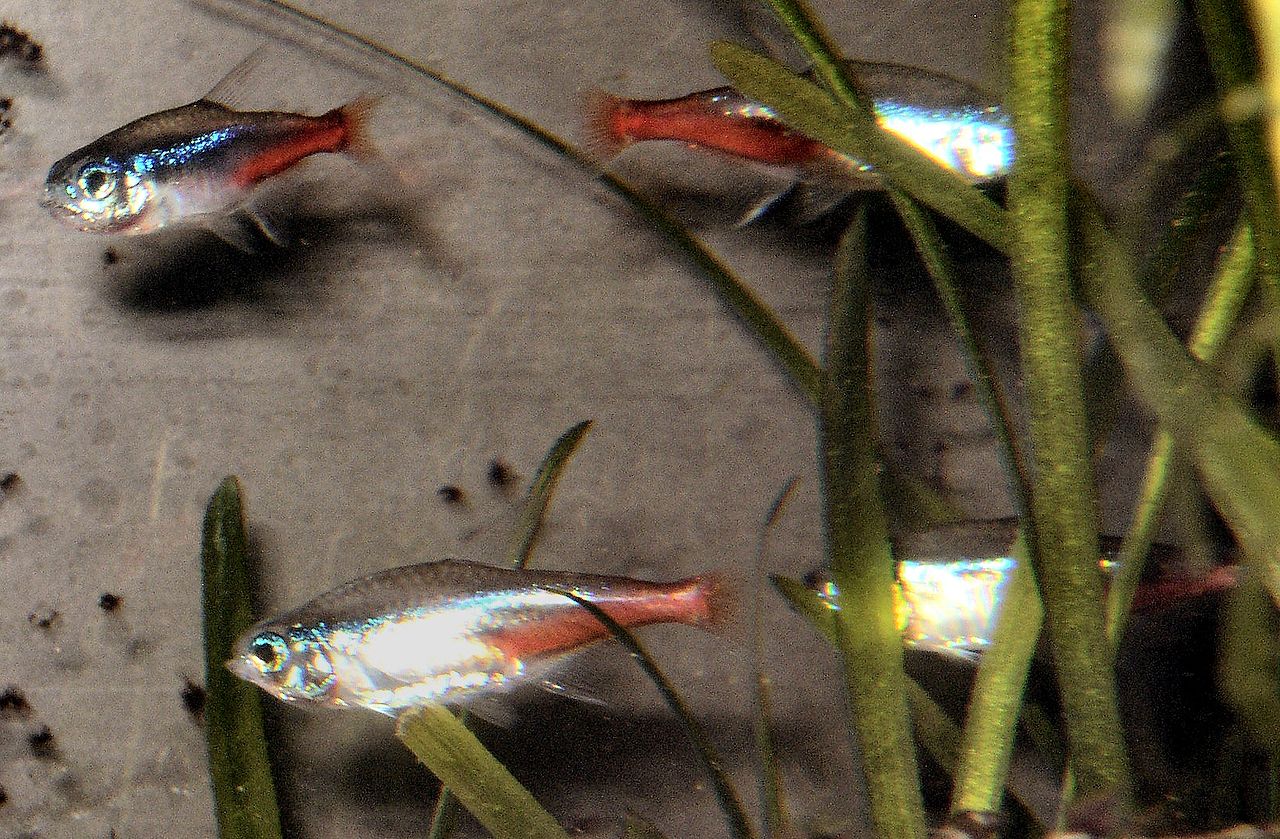
The detailed steps are in Acclimation. The time spent matching the temperature is time spent reducing the stress on the fish.
What are common mistakes with tropical fish water temperature?
The most common mistake is a heater that is too small. A thermometer next to the heater and forgetting to top up in summer are also common.
| Common mistake | What happens | What to do instead |
|---|---|---|
| A heater that is too small | The water does not reach the set temperature in winter | Use a wattage that suits the water volume |
| Thermometer next to the heater | Reads higher than the real temperature | Put it away from the heater |
| Forgetting to top up while using a cooling fan | The heater ends up above the waterline | Check the level daily and top up |
| Mixing fish whose ranges do not overlap | One of them ends up outside its range | Check the overlap in the table |
| Water changes with cold water | A sudden drop weakens the fish | Match the temperature before adding it |
| Cooling with a frozen bottle | Sudden cooling stresses the fish | Lower it with a fan or air conditioning |
Mind two things, where you measure and sudden changes, and you can prevent most water temperature mistakes.
What terms come up when talking about water temperature?
| Term | Meaning |
|---|---|
| Suitable temperature | The range of water temperatures in which a fish lives well |
| Preset heater | A heater that switches on and off at a fixed temperature |
| Thermostat | A device that controls the heater's temperature. Some are separate from the heater |
| Running dry | A heater getting hot out of the water. It can cause a fire |
| Cooling fan | A device that blows air across the surface to lower the temperature by evaporation |
| Aeration | Sending air bubbles into the water to dissolve oxygen in it |
| Acclimation | Getting new fish used to the tank's temperature and water quality little by little |
What else should you know along with water temperature?
Tropical fish water temperature is tied to choosing tank mates and preventing disease. Read these articles too.
- Compatibility and temperature together: Tropical Fish Tank Mates Chart
- A disease that often follows temperature swings: Ich (White Spot Disease)
- Steps for adding new fish: Acclimation
- For people about to start: Tropical Fish for Beginners
 Tank-mate chartTropical Fish Tank Mates Chart: 23 Species Rated ○△× with Reasons, Safe Sets and MistakesCheck tropical fish tank mates in order: temperature, size, fins and temperament, then shrimp. A ○△× chart for 23 species with reasons, safe sets and mistakes.Health and troubleIch Treatment and Causes: Temperature, Salt Baths and Medication in Order, Look-Alike Diseases, Tanks with Shrimp, Plants or Corydoras, and Goldfish or MedakaIch treatment from university and fisheries sources: the life cycle and temperature, telling ich from look-alikes, heat, salt or medication, shrimp tanks and goldfish.Care basicsHow to Acclimate Fish: Matching Temperature and Water, Drip and Cup Method Steps and Timing, and Notes for Shrimp, Medaka and GoldfishHow to acclimate fish, step by step with times for temperature and water. Drip vs cup method, why shrimp need longer, why bag water stays out, medaka and goldfish.Care basicsTropical Fish for Beginners: How to Choose Fish, What You Need, Typical Costs and the First MonthTropical fish for beginners: compare 7 species by size, temperature, pH, temperament and group size. What you need, 60 cm tank costs, the first month and common mistakes.
What are common questions about tropical fish water temperature?
Is 28°C too warm for tropical fish?
It depends on the fish. Guppies and cardinal tetras are within their ranges in the table, but 28°C is above the upper limit for neon tetras and panda corydoras.
If the water stays at 28°C, think about cooling it with a fan or similar.
What should you do if tropical fish water reaches 30°C?
Increase aeration, and cool the water with a cooling fan or by air conditioning the room. A manufacturer's guide says tropical fish do not cope well with water above 30°C.
Do not cool it suddenly. Bring it down over several hours.
Why won't the water reach the heater's set temperature?
Often the heater is too small for the water volume, or there is no lid and heat is escaping. A very cold room also makes the water hard to warm.
Recalculate the water volume and compare it with the wattage table.
Can you leave the heater on all the time?
Yes, leave it on. A heater senses the water temperature and switches itself on and off.
In summer, when the room is hot, remember that the water can warm up even while the heater is not running.
What water temperature is best for a shrimp tank?
Look at the ranges in the table for shrimp too. A manufacturer's guide says shrimp tend to be weak in high temperatures.
In summer, deal with temperature and oxygen in the shrimp tank first.
Sources
- GEX: Temperature control matters for tropical fish! Beating the summer heat (熱帯魚飼育には水温管理が大事!夏の暑さ対策, in Japanese. Suitable temperature of 25 to 26°C for tropical fish tanks, poor with water above 30°C, warm water loses oxygen, shrimp are weak in high temperatures, plants may die above 30 to 32°C, a cooling fan lowers it by about 3 to 4°C, chillers, days above 25°C in May, above 30 to 32°C is dangerous for goldfish and medaka)
- GEX: Aquarium heater wattage and tank size (水槽用ヒーターのワット数と水槽サイズの関係, in Japanese. Wattage by water volume, calculating the volume, choose the larger size in between, splitting across two heaters is fine, heaters switch on and off)
- Kotobuki Kogei: Aquarium heater instruction manual (観賞魚用ヒーター 取扱説明書, in Japanese. Water volume guide, assumes a room at 15°C or higher, a position below the waterline, unplug and wait about 15 minutes, circulate the water, thermometer away from the heater and checked once a day, thermometer error, replace about once a year, heaters do not lower the temperature)
- Tetra: Maintaining Water Quality and the Ideal Aquarium Temperature (do not take out a heater while it is on, match the temperature of water-change water, stick-on thermometers)
- Tetra: HT Submersible Heaters (a heater that is too small cannot heat the water enough, a lid traps heat)
- Aquarium Co-Op: How to Care for Your Aquarium Fish During a Power Outage (the first 1 to 2 hours, wrapping in blankets, number of heat packs, adding hot water, air every 8 hours, after the power returns, frozen bottles cool suddenly)
- Research Institute of Environment, Agriculture and Fisheries, Osaka Prefecture: Disease name: white spot disease (病名 白点病, in Japanese. Breaks out most easily around 20°C)
- UF/IFAS EDIS FA006: Ichthyophthirius multifiliis (White Spot) Infections in Fish (resistance tends to drop from autumn into winter, ich tends to occur with sudden temperature changes)
- UF/IFAS EDIS FA124: The Ornamental Fish Trade (get new fish used to the water little by little)
- ANGFA: Ichthyophthiriasis (dissolved oxygen drops by more than 17% from 20°C to 30°C)
- Seriously Fish: Oryzias latipes (medaka do better without a heater in most homes, always-warm water may shorten their lives)
Read next
Care basicsTM-12Tropical Fish for Beginners: How to Choose Fish, What You Need, Typical Costs and the First MonthTropical fish for beginners: compare 7 species by size, temperature, pH, temperament and group size. What you need, 60 cm tank costs, the first month and common mistakes. Care basicsTM-13How to Cycle a Fish Tank: How Long Filter Bacteria Take, the Steps, When to Add Fish, and Fixes for Cloudy Water or Weak FishHow to cycle a fish tank, explained through filter bacteria and the nitrogen cycle. Steps, timing, when and how many fish to add, testing, and fixes for cloudy water.Care basicsTM-15How to Acclimate Fish: Matching Temperature and Water, Drip and Cup Method Steps and Timing, and Notes for Shrimp, Medaka and GoldfishHow to acclimate fish, step by step with times for temperature and water. Drip vs cup method, why shrimp need longer, why bag water stays out, medaka and goldfish.