Tank mates by speciesTM-09
Angelfish Tank Mates: Good and Bad Partners, Why Grown Angelfish Eat Small Fish and Shrimp, Tank Size and How Many to Keep

Angelfish tank mates must be too big to fit in their mouths. Small fish can swim with young angelfish, but grown ones eat small fish and shrimp.

In this article (16 sections)
- In short: which tank mates suit angelfish?
- How do angelfish match up with the other 22 species?
- Why do angelfish eat small tank mates?
- Why can small fish swim with young angelfish but become unsafe as they grow?
- Can angelfish live with neon tetras or cardinal tetras?
- Can angelfish live with corydoras?
- Do angelfish eat shrimp?
- Can angelfish live with guppies, bettas or tiger barbs?
- How should you think about tank size and height for angelfish tank mates?
- How many angelfish should you keep?
- Before starting angelfish tank mates, what should you check, and in what order?
- What should you do when angelfish tank mates are not working?
- What terms come up with angelfish tank mates?
- What else goes with angelfish tank mates?
Frequently asked questions about angelfish tank mates5
- Sources
In short: which tank mates suit angelfish?
Angelfish tank mates are peaceful fish too big to fit in the angelfish's mouth. Of this site's 22 species, three are ○.
Angelfish are usually introduced as good community fish. The care resource Seriously Fish also calls them a good community fish.
But the same source says they may eat small fish such as tetras. The key point: choose angelfish tank mates by the size of the mouth once grown, not by the angelfish's size today.
| Result | Partners (this site's 22 species) |
|---|---|
| ○ (3 species) | Kuhli loach, bristlenose pleco, nerite snail |
| △ (3 species) | Panda corydoras, peppered corydoras, dwarf gourami |
| × (16 species) | Neon tetra, cardinal tetra, rummy-nose tetra, harlequin rasbora, zebra danio, cherry barb, otocinclus, guppy, platy, betta (male), tiger barb, medaka, goldfish, Neocaridina shrimp, red cherry shrimp, Amano shrimp |
What this article covers:
- Why small fish and shrimp are ×, and how things change as the angelfish grows
- Pairing with neon tetras, corydoras and guppies
- Tank size (width and height) and how many to keep
- What to check, in order, before adding fish, and what to do when it goes wrong
How do angelfish match up with the other 22 species?
○ Generally compatible (3)
- Kuhli loachBottom-dwelling kuhli loaches suit angelfish (Tokyo Aqua Garden (angelfish))
- Bristlenose pleco
- Nerite snail
△ With care (3)
- Panda coryBottom-dwelling corydoras are suggested as tank mates, but small individuals may be eaten (Tokyo Aqua Garden (angelfish)) / Temperature overlap is narrow (24–25°C)
- Peppered coryBottom-dwelling corydoras are suggested as tank mates, but small individuals may be eaten (Tokyo Aqua Garden (angelfish))
- Dwarf gouramiDwarf gourami is semi-aggressive and may harass long-finned Angelfish
× Not recommended (16)
- Neon tetraAdult angelfish may eat small fish such as tetras (Seriously Fish (Pterophyllum scalare)) / Neon tetra is small enough for Angelfish to eat / Temperature overlap is narrow (24–25°C)
- Cardinal tetraAdult angelfish may eat small fish such as tetras (Seriously Fish (Pterophyllum scalare)) / Cardinal tetra is small enough for Angelfish to eat
- Rummy-nose tetraRummy-nose tetra is small enough for Angelfish to eat
- GuppyGuppy is small enough for Angelfish to eat / Angelfish is semi-aggressive and may harass long-finned Guppy
- PlatyPlaty is small enough for Angelfish to eat
- Betta (male)Betta (male) is aggressive and chases other fish / Betta (male) is small enough for Angelfish to eat / Angelfish is semi-aggressive and may harass long-finned Betta (male)
- OtocinclusOtocinclus is small enough for Angelfish to eat
- Harlequin rasboraHarlequin rasbora is small enough for Angelfish to eat
- Zebra danioZebra danio is small enough for Angelfish to eat / Temperature overlap is narrow (24–25°C)
- Cherry barbCherry barb is small enough for Angelfish to eat
- Tiger barbTiger barb is small enough for Angelfish to eat / Tiger barb nips the long fins of Angelfish / Tiger barb is semi-aggressive and may harass long-finned Angelfish
- MedakaNo overlap in temperature (Angelfish 24–30°C, Medaka 16–22°C) / Medaka is small enough for Angelfish to eat / Angelfish is a tropical fish that needs a heater; Medaka does not
- GoldfishNo overlap in temperature (Angelfish 24–30°C, Goldfish 20–24°C) / Angelfish is a tropical fish that needs a heater; Goldfish does not
- Japanese swamp shrimpAngelfish readily eat small shrimp (Tokyo Aqua Garden (angelfish)) / Angelfish eats Japanese swamp shrimp
- Cherry shrimpAngelfish eats Cherry shrimp
- Amano shrimpEven the larger Amano shrimp get attacked by angelfish (Tokyo Aqua Garden (Amano shrimp)) / Angelfish eats Amano shrimp
Source: Judged by this site's rules from the care data of each species (see the sources of the care data table)
Angelfish are × with 16 species of fish and shrimp. The reasons fall into three main groups.
- Small enough to swallow: tetras, rasboras, zebra danio, otocinclus, guppy, platy and others
- Angelfish eat shrimp: Neocaridina shrimp, red cherry shrimp, Amano shrimp
- Temperature and heater: medaka and goldfish need no heater
The three △ pairs depend on conditions. Small corydoras may get eaten. Dwarf gouramis sometimes chase long fins.
The ○ partners are the bottom-swimming kuhli loach and bristlenose pleco, plus the nerite snail. For most × partners, the "fits in the mouth" reason remains even in a bigger tank.
Why do angelfish eat small tank mates?
Because angelfish grow large and are strongly carnivorous by nature. They may eat fish small enough to fit in their mouths.
Seriously Fish writes that they may eat small fish such as tetras. Tokyo Aqua Garden also says their natural diet is strongly carnivorous.
As the table shows, the body sizes differ a lot. Angelfish also grow very tall.
| Species | Adult size (cm) | Swimming level | Temperament | Group size (or more) |
|---|---|---|---|---|
| Neon tetra | 4 | Middle | Peaceful | 8 |
| Cardinal tetra | 3.5 | Middle | Peaceful | 8 |
| Rummy-nose tetra | 5 | Middle | Peaceful | 10 |
| Angelfish | 15 | Semi-aggressive | 5 | |
| Otocinclus | 3.5 | Bottom | Peaceful | 6 |
| Harlequin rasbora | 5 | Middle | Peaceful | 8 |
| Zebra danio | 5 | Middle | Peaceful | 8 |
Source (7)
Sources describe "too big to swallow" in different ways.
| Source | What it says about small fish |
|---|---|
| Seriously Fish | May eat small fish such as tetras |
| Tokyo Aqua Garden (species guide) | Small fish and fry are no exception. Fish too big to swallow rarely cause big trouble |
| Tokyo Aqua Garden (tank mates guide) | For small fish, a body length of 4 cm or more is one guideline |
| Aquarium Co-Op | They grow large, so avoid small animals that are small enough to eat |
This site's calculation marks a partner × if it is half the angelfish's size or smaller. Body length guidelines differ by source, so if you are unsure, treating the pair as × is the safe side.
Why can small fish swim with young angelfish but become unsafe as they grow?
Because angelfish sold in shops are still small juveniles. As they grow, their mouths get bigger, and they become able to eat the same partners.
Aquarium Co-Op recommends buying juveniles about the size of a coin. It says the fun is watching them grow from young fish into adults.
Tokyo Aqua Garden says you sometimes see them kept with neon tetras. But it says this only works for a limited time, while the angelfish are small.
| Stage | Angelfish | With small fish and shrimp | Source |
|---|---|---|---|
| When sold in shops | Juveniles. One source recommends buying them at about 2 to 3 cm | Often seen swimming alongside small fish | Aquarium Co-Op, Tokyo Aqua Garden |
| After growing | Body size as in the table. Even larger in height | May eat small fish such as tetras | Seriously Fish |
| Once a pair forms | The male holds a territory during breeding | Drives away fish that come near | Seriously Fish, Aquarium Co-Op |
Even with no problems on the first day, small fish may start to disappear months later. Decide on tank mates by how the angelfish will look once grown.
Even if they swim together in the shop's tank, that only reflects their size today. Choose partners by how the angelfish will look once grown.
Can angelfish live with neon tetras or cardinal tetras?
Both are × on this site. They are small enough to fit in a grown angelfish's mouth.
With neon tetras, a narrow temperature overlap adds to the reasons. The temperatures are in the table.
| Species | Adult size (cm) | Temperature (°C) | pH |
|---|---|---|---|
| Neon tetra | 4 | 21–25 | 4–7.5 |
| Cardinal tetra | 3.5 | 23–29 | 3.5–7.5 |
| Angelfish | 15 | 24–30 | 6–7.4 |
Source: Seriously Fish (Paracheirodon innesi) / Seriously Fish (Paracheirodon axelrodi) / Seriously Fish (Pterophyllum scalare)
Sources see this pair differently.
| Source | View on neon tetras and cardinal tetras |
|---|---|
| Seriously Fish (angelfish) | May eat small fish such as tetras |
| Tokyo Aqua Garden (tank mates guide) | Neons work only for a limited time while the angelfish are small. Cardinals are bigger and recommended |
| Tokyo Aqua Garden (neon tetra guide) | Swimming with slightly bigger fish helps neons form a school |
| Aquarium Co-Op | Worked well with adult cardinal tetras |
| This site's calculation | Both judged small enough to swallow |
This site follows what Seriously Fish says. If you want to keep a school of small fish, a tank separate from angelfish is the safe choice.
Compatibility from the neon tetra's side is in Neon Tetra Tank Mates.
Can angelfish live with corydoras?
Panda corydoras and peppered corydoras are both △. They swim on the bottom, so they are named as partners, but small ones may get eaten.
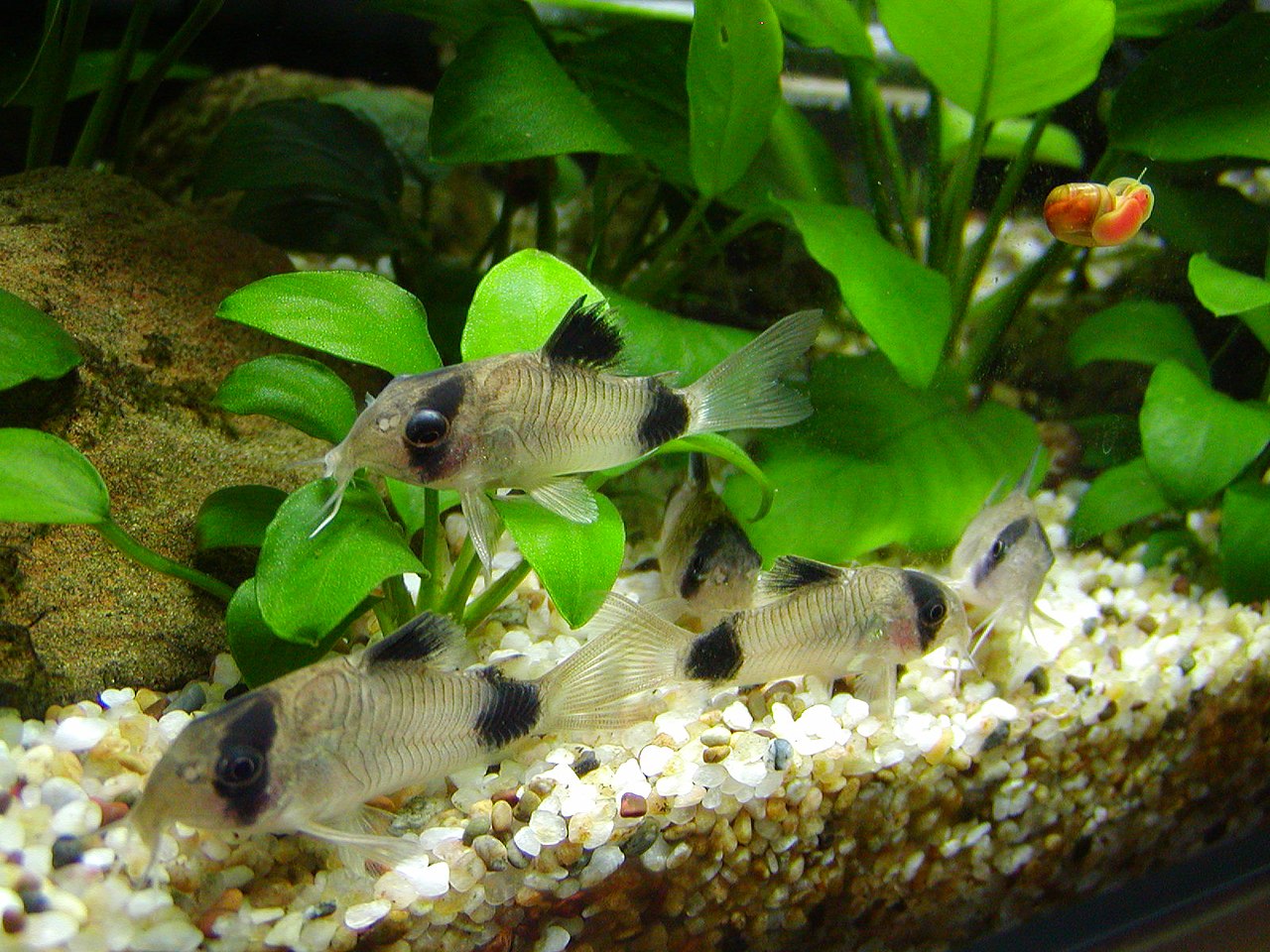
Tokyo Aqua Garden says corydoras and kuhli loaches, which swim near the bottom, suit angelfish. It explains that corydoras are covered in tough skin, so pecking rarely injures them.
Aquarium Co-Op also writes that corydoras worked well. On the other hand, Tokyo Aqua Garden also says small fish are no exception.
| Species | Adult size (cm) | Temperature (°C) | Swimming level | Group size (or more) |
|---|---|---|---|---|
| Angelfish | 15 | 24–30 | 5 | |
| Panda cory | 5 | 22–25 | Bottom | 6 |
| Peppered cory | 7 | 22–26 | Bottom | 5 |
| Kuhli loach | 10 | 21–26 | Bottom | 5 |
| Bristlenose pleco | 12.5 | 21–26 | Bottom | 1 |
Source (5)
Conditions if you try it:
- Choose corydoras that are grown and fairly large
- Keep them in the group size shown in the table
- Panda corydoras have a narrow temperature overlap. Keep the water at a temperature that suits both
- Check that food sinking to the bottom reaches the corydoras
The △ for corydoras means "with a condition: avoid small ones." Compatibility from the corydoras's side is in Corydoras Tank Mates.
Do angelfish eat shrimp?
Yes. All three shrimp, including the Amano shrimp, are ×.
Tokyo Aqua Garden writes that angelfish like to eat small shrimp. Its guide to Amano shrimp also says medium-sized fish attack them.
Aquarium Co-Op also says to avoid small shrimp, because angelfish grow large.
| Shrimp and snails | Result | Reason |
|---|---|---|
| Neocaridina shrimp | × | Angelfish like to eat small shrimp |
| Red cherry shrimp | × | Angelfish eat small shrimp |
| Amano shrimp | × | Even larger shrimp get attacked |
| Nerite snail | ○ | Temperature and water overlap, and neither eats the other |
If you want an algae eater, the ○ choices are the nerite snail or the bristlenose pleco, not shrimp. Shrimp compatibility in general is in Fish That Can Live with Shrimp.
Shrimp may be handy for algae, but to an angelfish they are food. Use snails or plecos as cleaners.
Can angelfish live with guppies, bettas or tiger barbs?
All are ×. The reasons involve the angelfish's long fins, plus being small enough to swallow.
| Partner | Result | Main reason |
|---|---|---|
| Guppy | × | Small enough to swallow. Angelfish may also chase long-finned guppies |
| Betta (male) | × | Male bettas chase other fish. Also small enough to swallow |
| Tiger barb | × | Nips the angelfish's long fins |
| Dwarf gourami | △ | Somewhat aggressive, and sometimes chases the long-finned angelfish |
Tokyo Aqua Garden writes that tiger barbs nip the long fins of angelfish. Aquarium Co-Op also says to avoid fin nippers.
Aquarium Co-Op also says to avoid fast-moving fish, because angelfish lose out to them at feeding time.
As a rule, do not keep angelfish with fin nippers, whatever their size. The guppy's side is in Guppy Tank Mates.
How should you think about tank size and height for angelfish tank mates?
Angelfish are tall, so choose a tank with height, not just width. The guidelines in the sources are below.
| Guideline | Details | Source |
|---|---|---|
| Smallest tank | 100×40×50 cm | Seriously Fish |
| Tank height | A tall tank of 50 cm or more for adults | Seriously Fish |
| For a lifetime | 45 cm or more in height | Tokyo Aqua Garden (species guide) |
| With tank mates | At least 60 cm wide | Tokyo Aqua Garden (tank mates guide) |
| Community tank of about 110 L (29 gallons) | Up to 4 adult angelfish | Aquarium Co-Op |
| About 208 L (55 gallons) | Start with 5 to 6 juveniles | Aquarium Co-Op |
The figures vary by source, but all of them put weight on height.
When you add tank mates, choose a tank with room for the angelfish plus room for the partners' group.
Measure the height, not just the width, before you choose. Angelfish need room to swim with their fins spread.
How many angelfish should you keep?
You can keep one, or a small group. They squabble with their own kind, so sources recommend a small group.
| How to keep them | What the source says | Source |
|---|---|---|
| One | Does well alone and can become calmer | Aquarium Co-Op |
| A small group | They squabble with their own kind, so keep a small group | Seriously Fish |
| An odd number of 3 or more | Aggression is spread out, which tends to work | Tokyo Aqua Garden (tank mates guide) |
| Forming a pair | Raising 6 juveniles lets a pair form | Seriously Fish, Aquarium Co-Op |
| Species | Angelfish |
|---|---|
| Scientific name | Pterophyllum scalare |
| Adult size | 15 |
| Temperature | 24–30 |
| pH | 6–7.4 |
| Temperament | Semi-aggressive |
| Group size | 5 |
| Tank-mate notes | Adults may eat small fish such as tetras. |
Source: Seriously Fish (Pterophyllum scalare)
Territorial behavior gets stronger mainly during breeding. Seriously Fish says males become more territorial in the breeding season.
Aquarium Co-Op also writes that territorial behavior is mostly about breeding.
Once a pair forms, check every day that other fish are not being chased. If the chasing continues, move the pair or the partner to another tank.
Before starting angelfish tank mates, what should you check, and in what order?
Check the partner's result, its grown size, temperature, tank height, then hiding places. Remove × partners at this stage.
| What to check | Where to look | Decision |
|---|---|---|
| Partner's result | The compatibility list above | Do not add ×. For △, read the reason |
| Grown size | Adult size in the table | Remove partners half the size or smaller |
| Temperature | Temperature in the table, and heater needs | For a narrow overlap, set a temperature that suits both |
| Tank height | Sources suggest at least 45 to 50 cm | If too low, reduce the partners |
| Hiding places | Plants and shelters | Make places where chased fish can escape |
| Fin nipping | Partner's temperament and notes | Remove tiger barbs and similar fish |
Tokyo Aqua Garden says always to provide hiding places such as plants or shelters. They give chased fish somewhere to escape to.
Other pairs can be checked with the quick chart and checker in the Tropical Fish Tank Mates Chart. Before adding fish, check once more against how the angelfish will look when grown.
What should you do when angelfish tank mates are not working?
If small fish vanish, fins get torn, or a fish is chased nonstop, separate the partner causing it. Then watch whether both settle down.
| What you see | What may be happening | What to do |
|---|---|---|
| Small fish slowly disappear | The angelfish has grown and can now swallow them | Move the small fish to another tank |
| Shrimp disappear | The angelfish is eating the shrimp | Move the remaining shrimp to another tank |
| The angelfish's fins are torn | A fin nipper is in the tank | Separate the partner. Recheck for × fish |
| One fish is chased nonstop | A pair has formed and holds a territory | Move the chased fish, or add hiding places |
| The angelfish gets thin | Fast fish are taking its food | Separate the fast fish. Drop food in different spots |
If fin wounds turn cloudy white, disease may have set in. If you use medicine, check its generic name and follow the instructions.
Keeping one spare tank for separating fish saves you from panicking.
What terms come up with angelfish tank mates?
| Term | Meaning |
|---|---|
| Tank mates (混泳) | Keeping different kinds of fish or shrimp in the same tank |
| Cichlid (シクリッド) | The group of fish that includes the angelfish. Many hold territories |
| Juvenile (幼魚) | A young fish not yet adult. Most angelfish sold in shops are juveniles |
| Body height (体高) | The height from the base of the dorsal fin to the belly. Angelfish are very tall |
| Pair (ペア) | A male and female that have teamed up to breed |
| Territory (縄張り) | An area a fish guards as its own, driving other fish away |
| Fin nipping (ヒレかじり) | A habit of biting other fish's fins |
| Bottom level (底層) | The area near the bottom of the tank, where corydoras and kuhli loaches swim |
What else goes with angelfish tank mates?
Angelfish tank mates connect to small fish, bottom fish and shrimp. Go on to the article for the partner you are curious about.
- Small fish in the middle level: Neon Tetra Tank Mates
- Partners on the bottom: Corydoras Tank Mates
- Long-finned fish: Guppy Tank Mates
- Shrimp compatibility in general: Fish That Can Live with Shrimp
- Livebearers that are easy to swallow: Platy Tank Mates
- Quick chart and checker for 23 species: Tropical Fish Tank Mates Chart
 Tank mates by speciesNeon Tetra Tank Mates: 22 Species Rated ○△× with Reasons, plus Medaka, Shrimp, CardinalsNeon tetra tank mates for 22 species, rated ○△× with reasons. Bettas, angelfish and goldfish are ×. Medaka, tiger barbs, shrimp and cardinals, with sources.
 Tank mates by speciesCorydoras Tank Mates: 22 Species Rated ○△×, Shrimp, Crowded Bottoms and How Many to KeepCorydoras tank mates for 22 species, rated ○△× with reasons. Bettas, medaka and goldfish are ×. Shrimp, sharing the bottom with plecos, and how many to keep.
 Shrimp and snailsWhich Fish Can Live with Shrimp? Neocaridina and Amano Ratings, Hiding Places, AcclimationShrimp tank mates rated ○△× with reasons for Neocaridina and Amano shrimp. Fish that eat baby shrimp vs adults, willow moss hiding places and acclimation steps.
 Tank mates by speciesPlaty Tank Mates: Good and Bad Partners, Keeping Platies with Guppies, Shrimp and Neon Tetras, and Protecting FryPlaties are ○ with most small, peaceful fish. Platy tank mates for 22 species rated ○△× with reasons, guppies, neons, shrimp, fry, too many babies and tank size.
 Tank-mate chartTropical Fish Tank Mates Chart: 23 Species Rated ○△× with Reasons, Safe Sets and MistakesCheck tropical fish tank mates in order: temperature, size, fins and temperament, then shrimp. A ○△× chart for 23 species with reasons, safe sets and mistakes.
Frequently asked questions about angelfish tank mates
Which fish can live with angelfish?
Of this site's 22 species, three are ○: the kuhli loach, bristlenose pleco and nerite snail. The two corydoras and the dwarf gourami are △.
Tetras and small livebearers are × because they fit in a grown angelfish's mouth. Choose partners by the size of the mouth once grown.
Can angelfish live with guppies?
They are ×. Guppies are small enough to swallow, and angelfish may also chase long-finned guppies.
Aquarium Co-Op says "it depends," because guppies are small. Guppies are safer kept with their own kind.
Can angelfish live with other angelfish?
Yes. Sources recommend one, or a small group.
They sometimes squabble with their own kind, and territorial behavior gets stronger in the breeding season. An odd number of 3 or more spreads out aggression more easily (Tokyo Aqua Garden).
Can angelfish live with goldfish?
They are ×. Their temperatures do not overlap, and their heater needs differ.
Angelfish are tropical fish that need a heater, and goldfish do not need one. Keep goldfish with goldfish.
What algae eater suits an angelfish tank?
The bristlenose pleco and the nerite snail are ○. The otocinclus is × because it is small enough to swallow, and all three shrimp are × too.
Choose algae eaters, too, by whether they would fit in a grown angelfish's mouth.
Sources
- Seriously Fish: Pterophyllum scalare (a good community fish, eats small fish such as tetras, squabbles with its own kind, small groups, a pair from 6 juveniles, territorial males in the breeding season, tank size and height)
- Tokyo Aqua Garden: Angelfish (エンゼルフィッシュ, in Japanese. Strongly carnivorous, likes to eat small shrimp, small fish and fry are no exception, corydoras and kuhli loaches near the bottom, 45 cm or more in height)
- Tokyo Aqua Garden: Fish you can keep with angelfish (エンゼルフィッシュと一緒に飼える魚, in Japanese. Neons only for a limited time, the 4 cm guideline, cardinals, corydoras skin, tiger barbs, at least 60 cm wide, an odd number of 3 or more, hiding places)
- Tokyo Aqua Garden: Amano shrimp (ヤマトヌマエビ, in Japanese. Attacked by medium-sized fish)
- Aquarium Co-Op: Angelfish Care Guide (worked with cardinals and corydoras, guppies depend, avoid fin nippers and fast fish, avoid small shrimp, tank size and numbers, buying juveniles, territory is about breeding)
Read next
Tank mates by speciesTM-02Neon Tetra Tank Mates: 22 Species Rated ○△× with Reasons, plus Medaka, Shrimp, CardinalsNeon tetra tank mates for 22 species, rated ○△× with reasons. Bettas, angelfish and goldfish are ×. Medaka, tiger barbs, shrimp and cardinals, with sources. Tank mates by speciesTM-03Can Bettas Have Tank Mates? Why Males Live Alone, plus Cherry Barbs, Shrimp, SnailsA male betta is best kept alone. Betta tank mates for 22 species rated ○△× with reasons, the cherry barb, shrimp and snail exceptions, and fixes if it fails.
 Tank mates by speciesTM-04Guppy Tank Mates: Good and Bad Partners, plus Shrimp, Fry and Keeping Guppies with PlatiesGuppies are ○ with most small, peaceful fish. Guppy tank mates for 22 species rated ○△× with reasons, fin nippers, platies, shrimp, medaka, fry and tank size.Tank mates by speciesTM-05Corydoras Tank Mates: 22 Species Rated ○△×, Shrimp, Crowded Bottoms and How Many to KeepCorydoras tank mates for 22 species, rated ○△× with reasons. Bettas, medaka and goldfish are ×. Shrimp, sharing the bottom with plecos, and how many to keep.Tank mates by speciesTM-07Medaka Tank Mates: 22 Species Rated ○△× with Reasons, plus Tropical Fish, Shrimp, Nerite Snails, Goldfish and No HeaterMedaka tank mates for 22 species, rated ○△× with reasons. Three shrimp and the nerite snail are ○. Why tropical fish are △ or ×, goldfish, and outdoor ponds.
 Tank mates by speciesTM-08Goldfish Tank Mates: 22 Species Rated ○△× with Reasons, plus Tropical Fish, Shrimp, Medaka, Cleaners and Goldfish VarietiesGoldfish tank mates for 22 species, rated ○△× with reasons. Why small fish and shrimp are ×, why tropical fish are △, medaka, nerite snails and tank size.Tank mates by speciesTM-10Platy Tank Mates: Good and Bad Partners, Keeping Platies with Guppies, Shrimp and Neon Tetras, and Protecting FryPlaties are ○ with most small, peaceful fish. Platy tank mates for 22 species rated ○△× with reasons, guppies, neons, shrimp, fry, too many babies and tank size.Tank mates by speciesTM-11Otocinclus Tank Mates: 22 Species Rated ○△× with Reasons, Why They Get Bullied, Medaka, Goldfish, Shrimp, Algae and FoodOtocinclus tank mates for 22 species rated ○△× with reasons. Why otos get bullied, × bettas, angels and goldfish, △ medaka and shrimp, algae, food and numbers.