Tank mates by speciesTM-02
Neon Tetra Tank Mates: 22 Species Rated ○△× with Reasons, plus Medaka, Shrimp, Cardinals
Neon tetras are safe with small, peaceful fish that have small mouths, bottom dwellers and shrimp. Avoid bettas, angelfish and goldfish.

In this article (16 sections)
- In short: which fish are safe tank mates for neon tetras?
- In what order do you check neon tetra tank mates?
- Which fish are × with neon tetras?
- Which medium-sized or larger fish can live with neon tetras?
- Can neon tetras live with medaka?
- Can neon tetras live with guppies and platies?
- Why are neon tetras and tiger barbs △?
- Can neon tetras live with shrimp and algae eaters?
- How do cardinal tetras differ from neon tetras, and can they live together?
- How do you plan tank size and numbers for neon tetra tank mates?
- What should you do before adding tank mates to neon tetras?
- What are common mistakes with neon tetra tank mates?
- What terms come up with neon tetra tank mates?
- What else goes with neon tetra tank mates?
Frequently asked questions about neon tetra tank mates6
- Sources
In short: which fish are safe tank mates for neon tetras?
Neon tetras are safe with small, peaceful fish that have small mouths, bottom dwellers and shrimp. The three to avoid are the betta (male), the angelfish and the goldfish.
The neon tetra is a small, peaceful tropical fish that swims in schools in the middle of the tank. Shop guides and fishkeeping books both recommend "peaceful fish of about the same size" as partners.
The trouble is that people draw the line for "about the same size" and "peaceful" in different places. This site calculates compatibility from the care data of 22 species and shows it as ○△× with a reason.
What this article covers:
- Compatibility with 22 species, and why some are × or △
- How to think about keeping them with medaka
- Compatibility with shrimp and algae eaters
- How to tell cardinal tetras from neon tetras
- Tank size, number of fish, and what to do before adding fish
○ Generally compatible (17)
- Cardinal tetra
- Rummy-nose tetra
- Guppy
- Platy
- Panda cory
- Peppered cory
- Otocinclus
- Harlequin rasbora
- Zebra danio
- Cherry barb
- Dwarf gourami
- Kuhli loach
- Bristlenose pleco
- Japanese swamp shrimp
- Cherry shrimpNeon tetras like similar water and suit cherry shrimp (Tokyo Aqua Garden (cherry shrimp))
- Amano shrimp
- Nerite snail
△ With care (2)
- Tiger barbTiger barb may nip other fish's fins
- MedakaTemperature overlap is narrow (21–22°C) / Neon tetra is a tropical fish that needs a heater; Medaka does not
× Not recommended (3)
- Betta (male)Betta (male) is aggressive and chases other fish
- AngelfishAdult angelfish may eat small fish such as tetras (Seriously Fish (Pterophyllum scalare)) / Neon tetra is small enough for Angelfish to eat / Temperature overlap is narrow (24–25°C)
- GoldfishNeon tetra is small enough for Goldfish to eat / Neon tetra is a tropical fish that needs a heater; Goldfish does not
Source: Judged by this site's rules from the care data of each species (see the sources of the care data table)
Here is the list above, grouped by compatibility.
| Compatibility | Partners | Main reason |
|---|---|---|
| × not suitable | Betta (male), angelfish, goldfish | Chases other fish, or is big enough to swallow a neon |
| △ with conditions | Tiger barb, medaka | Nips fins, or the temperatures overlap only a little |
| ○ easy to keep together | The other 17 species (including shrimp and snails) | The temperatures overlap, and neither eats the other |
The key point: neon tetra tank mates are decided mostly by three things: water temperature, mouth size and temperament.
In what order do you check neon tetra tank mates?
Check neon tetra tank mates in this order: water temperature, mouth size, temperament, then shrimp. The three × species all fail at the second or third step.
For the neon tetra, the four steps look like this.
| What to check | For the neon tetra | Partners that fail |
|---|---|---|
| Do the temperatures overlap? | The top of its suitable range is a little low (see the table) | Medaka (narrow overlap) |
| Is one big enough to swallow the other? | Small body, so it is the one that gets eaten | Angelfish, goldfish |
| Fin nipping and temperament | Peaceful, and its fins are not long | Betta (male), tiger barb |
| Does it eat shrimp? | No source says it does | None (all three shrimp are ○) |
The order matters. A partner whose temperature does not match cannot live in the same tank for long, even if everything else matches.
Check temperature first and mouth size second, and you will rule out almost every × for neon tetras. Temperament varies from fish to fish, so check it last.
Which fish are × with neon tetras?
The three × species for neon tetras are the betta (male), the angelfish and the goldfish. The betta chases other fish, and the other two grow big enough to swallow a neon.
Each of the three is × for a different reason.
| Partner | Why it is × | Source |
|---|---|---|
| Betta (male) | Aggressive, and chases other fish | Best kept alone, and keeping it with other species is the exception (Seriously Fish) |
| Angelfish | Grows big enough to swallow a neon tetra | May eat small fish such as tetras as it grows (Seriously Fish) |
| Goldfish | Big enough to swallow a neon, and only one needs a heater | Partners must be larger than the goldfish's mouth (RSPCA Australia) |
Angelfish are often still small when they are sold in shops. They may swim together while small, but as the angelfish grows, so does its mouth.

Do not judge an angelfish by its size when you buy it. Think about how big its mouth will be when it is grown, and you will avoid this mistake.
Pairs with the betta are covered in detail in Betta Tank Mates. Adding hiding places does not remove the reasons behind these three ×, so the simplest way is never to add them.
Which medium-sized or larger fish can live with neon tetras?
Among the 22 species in this table, the dwarf gourami, the kuhli loach and the bristlenose pleco are ○. All three are bigger than a neon tetra, but none of them eats small fish.
Under this site's rules, being large alone does not make a fish ×. What counts is whether the neon fits in its mouth, and its temperament.
Seriously Fish names fish like these as partners for neon tetras.
- Characins (relatives of the tetras) of about the same size
- Small catfish such as corydoras
When you choose a larger fish, look at these three things.
| What to look at | ○ side | × or △ side |
|---|---|---|
| Food | Eats plants or a mixed diet, and does not chase small fish | Eats small fish |
| Temperament | Peaceful | Aggressive or somewhat aggressive |
| Size gap | The neon does not fit in its mouth | A fish half its size or smaller fits in its mouth |
Male dwarf gouramis fight each other, so the basic rule is to add just one. Choose larger partners by two things: the size of the mouth once grown, and temperament.
Can neon tetras live with medaka?
Neon tetras and medaka are △ (with conditions). Their suitable temperatures overlap only a little, and one needs a heater while the other does not.
It is a pair many people wonder about, and "neon tetra medaka" shows up in search suggestions. Both are peaceful and close in size.
But they like different temperatures. Seriously Fish calls the medaka a temperate to subtropical fish. It also says that in most homes the medaka does better without a heater.
| Species | Temperature (°C) | pH | Swimming level | Group size (or more) |
|---|---|---|---|---|
| Neon tetra | 21–25 | 4–7.5 | Middle | 8 |
| Medaka | 16–22 | 6.5–8.5 | Top | 8 |
Source: Seriously Fish (Paracheirodon innesi) / Seriously Fish (Oryzias latipes)
As the table shows, the ranges meet only at the top end of the medaka's range and the bottom end of the neon tetra's. The same source says that water that is always warm may shorten a medaka's life.
Some shop guides do list medaka as a partner for neon tetras. If you keep them together, follow these points.
- Check the thermometer every day and keep the water inside the overlap in the table
- Watch for both high water temperature in summer and cold in winter
- Keep both species in schools (group sizes are in the table)
- The two use different levels: medaka at the top, neon tetras in the middle
If you keep them together, put the thermometer at eye level. Where you look every day, you will notice any drift right away.
The two species have to share a narrow band of temperature, so separate tanks are easier to manage. Good partners for medaka also include nerite snails and Neocaridina shrimp, which come out ○ in our calculation.
Can neon tetras live with guppies and platies?
Yes. Neon tetras are ○ with both the guppy and the platy, and they use different levels of the tank.
Guppies and platies swim near the top, and neon tetras in the middle. Their preferred water chemistry (pH) overlaps around neutral.

The thing to watch is the guppy's long fins. Guppies are × with tiger barbs, so do not add tiger barbs to a tank with these three species.
The classic layout is guppies or platies at the top, neon tetras in the middle and corydoras on the bottom. For compatibility from the guppy's side, see Guppy Tank Mates.
Why are neon tetras and tiger barbs △?
Because tiger barbs sometimes nip the fins of other fish. Neon tetras do not have long fins, so the pair is △ rather than ×.
Seriously Fish describes the tiger barb as a fish known for fin nipping. It also says that in a large enough group, they nip at each other within the group and settle down.
| Pair | Compatibility | Reason |
|---|---|---|
| Tiger barb × neon tetra | △ | Sometimes nips fins |
| Tiger barb × corydoras | △ | Sometimes nips fins |
| Tiger barb × guppy | × | Nips long fins |
| Tiger barb × zebra danio | ○ | Recommended as a fast-swimming partner |
If you add tiger barbs, keep them as a group of their own and leave out long-finned fish.
Can neon tetras live with shrimp and algae eaters?
Yes. Neon tetras are ○ with all three shrimp, the nerite snail and the otocinclus.
Tokyo Aqua Garden names the neon tetra as a good partner for cherry shrimp, because they like similar water.

The animals people often add to clean up algae are also ○ with neon tetras. But compatibility among those animals needs a separate look.
| 1 | 2 | 3 | 4 | 5 | 6 | |
|---|---|---|---|---|---|---|
| 1Neon tetra | · | ○ | ○ | ○ | ○ | ○ |
| 2Cardinal tetra | ○ | · | ○ | ○ | ○ | ○ |
| 3Harlequin rasbora | ○ | ○ | · | ○ | ○ | ○ |
| 4Panda cory | ○ | ○ | ○ | · | ○ | ○ |
| 5Otocinclus | ○ | ○ | ○ | ○ | · | △ |
| 6Japanese swamp shrimp | ○ | ○ | ○ | ○ | △ | · |
○ Generally compatible △ With care × Not recommended
Source: Judged by this site's rules from the care data of each species (see the sources of the care data table)
There is one △ in the quick chart above: otocinclus with Neocaridina shrimp. Otocinclus sometimes pick at baby shrimp, but adult shrimp survive.
Aquarium Co-Op says most fish eat baby shrimp. If you want the shrimp to breed, keep thick clumps of plants.
For compatibility from the shrimp's side, see Shrimp Tank Mates.
How do cardinal tetras differ from neon tetras, and can they live together?
Cardinal tetras and neon tetras are ○. Tell them apart by the red stripe: on a cardinal it runs forward to the front of the belly, and on a neon only along the back half.
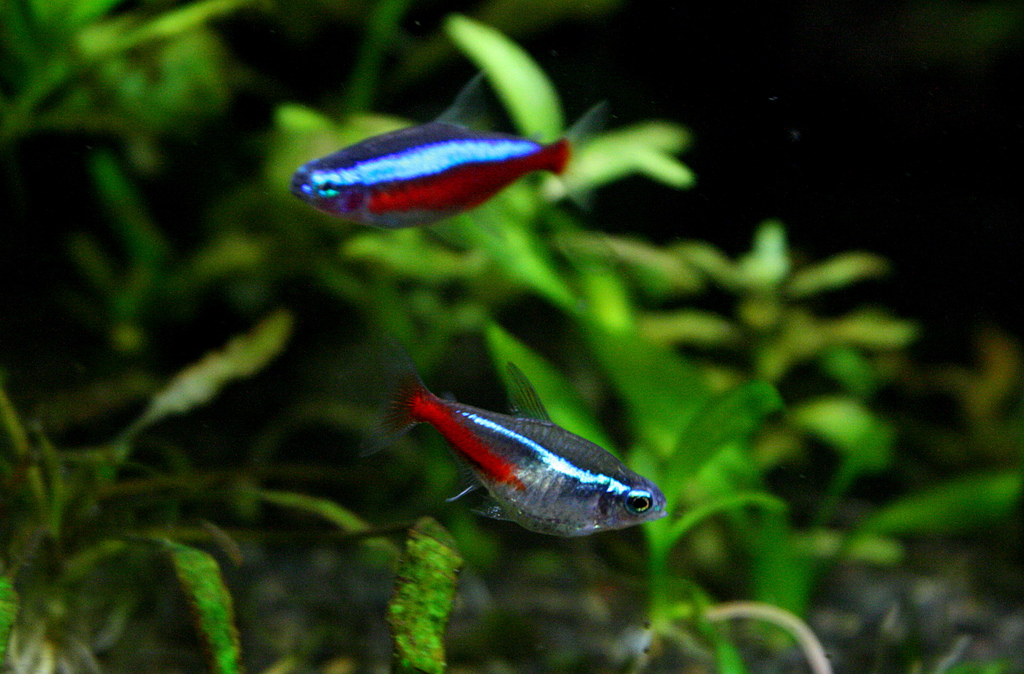
Seriously Fish describes the differences between the two like this.
| What to look at | Neon tetra | Cardinal tetra |
|---|---|---|
| Red stripe | Less red, only behind the pelvic fins | Red runs forward past the base of the pelvic fins |
| Blue stripe | Fairly thin | Wide, and runs far back toward the tail |
| Fish on sale | Almost all farmed | Many are still caught in the wild |
The cardinal tetra likes warmer water.
| Species | Adult size (cm) | Temperature (°C) | pH | Group size (or more) |
|---|---|---|---|---|
| Neon tetra | 4 | 21–25 | 4–7.5 | 8 |
| Cardinal tetra | 3.5 | 23–29 | 3.5–7.5 | 8 |
Source: Seriously Fish (Paracheirodon innesi) / Seriously Fish (Paracheirodon axelrodi)
As the table shows, the overlap is in the upper part of the neon tetra's suitable range. If you keep them together, set the temperature inside that overlap.
The same source says wild-caught cardinals are sensitive to dirty water. When you add cardinals, it is safer to do water changes more often than with neon tetras alone.
How do you plan tank size and numbers for neon tetra tank mates?
Keep a full group of neon tetras, and give enough space for the partners' groups too. The source recommends a tank with a base of at least 60 cm wide × 30 cm deep.
These are the tank guidelines from Seriously Fish's neon tetra page.
| Item | Guideline |
|---|---|
| Tank base | At least 60 cm wide × 30 cm deep |
| Number of fish | A group of mixed males and females (group size is in the table) |
| Good fish to add | Other schooling fish. They help the neons swim with confidence |
| Light | They do well under fairly dim lighting |
| Layout | A sandy bottom and driftwood suit them well |

In a community tank, each species needs its own group. With a school of neon tetras, a group of top swimmers and a group of corydoras on the bottom, the numbers add up fast.
Add up the group size of each species, and check that the total fits the tank. For how bottom dwellers take up floor space, see Corydoras Tank Mates.
What should you do before adding tank mates to neon tetras?
Before you mix fish with neon tetras, look up the partner's habits, and keep new fish in a separate tank first. A University of Florida guide recommends watching them for at least 30 days.
Here are the steps from the University of Florida (UF/IFAS) guides, in order.
- Before you buy, look up the fish's temperament and how it behaves with other fish
- Do not choose fish that look weak or show signs of disease
- Keep new fish in a separate tank for at least 30 days and watch them
- Get them used to the main tank's water little by little, then release them
Ich (white spot disease, which causes white spots on the body) often comes in with new fish. The same guide says it can appear 1 to 3 weeks after the fish are shipped.
Neon tetras also have an illness called "neon tetra disease." Seriously Fish advises against buying fish that show symptoms.
The quarantine tank can be small. While you wait 30 days, you can also check that the fish eat well.
Not putting new fish straight into the main tank does more than anything else to prevent tank mate failures.
What are common mistakes with neon tetra tank mates?
There are three common mistakes: choosing fish whose mouths grow big, pairing with fish that need a different temperature, and adding new fish straight away.
| Common mistake | What happens | What to do instead |
|---|---|---|
| Adding a small angelfish | As it grows, it eats the neon tetras | Never add × partners in the first place |
| Adding neons to a medaka tank | They like different temperatures | Keep the water inside the overlap, or use separate tanks |
| Keeping too few | They do not form a school and do not settle | Keep at least the group size |
| Tiger barbs together with guppies | The long fins get nipped | Keep long-finned fish and tiger barbs apart |
| Adding new fish straight away | Ich and other diseases come in | Keep them in a separate tank for at least 30 days |
| Fish in the middle eat all the food | It never reaches the corydoras on the bottom | Give separate food that sinks to the bottom |
If it is not working, move the fish doing the chasing, or the weakened fish, to another tank or behind a divider. The basic fix for a bad pair is to separate them, not to make them put up with it.
What terms come up with neon tetra tank mates?
| Term | Meaning |
|---|---|
| Tank mates (混泳) | Keeping different kinds of fish or shrimp together in the same tank |
| Middle, top and bottom levels (中層, 上層, 底層) | The middle of the tank, near the surface, and near the bottom. Each fish swims at its own height |
| Group size (群れの目安) | The smallest number of its own kind a fish needs to live calmly |
| Characin (カラシン) | A name that groups the tetras and their relatives |
| Fin nipping (ヒレかじり) | Pecking and biting at other fish's fins |
| Baby shrimp (稚エビ) | Newborn, small shrimp |
| Quarantine tank (様子見の水槽) | A tank where new fish are kept apart before going into the main tank |
| pH | How acidic or alkaline the water is. 7 is neutral |
What else goes with neon tetra tank mates?
Neon tetra tank mates connect to the compatibility of bottom dwellers, shrimp and other fish. Go on to the next article from the partner you are curious about.
- Partners on the bottom: Corydoras Tank Mates
- Shrimp and snails: Shrimp Tank Mates
- Partners near the top: Guppy Tank Mates
- All 22 species at once: Tropical Fish Tank Mates Chart
 Tank mates by speciesCorydoras Tank Mates: 22 Species Rated ○△×, Shrimp, Crowded Bottoms and How Many to KeepCorydoras tank mates for 22 species, rated ○△× with reasons. Bettas, medaka and goldfish are ×. Shrimp, sharing the bottom with plecos, and how many to keep.
 Tank-mate chartTropical Fish Tank Mates Chart: 23 Species Rated ○△× with Reasons, Safe Sets and MistakesCheck tropical fish tank mates in order: temperature, size, fins and temperament, then shrimp. A ○△× chart for 23 species with reasons, safe sets and mistakes.
 Shrimp and snailsWhich Fish Can Live with Shrimp? Neocaridina and Amano Ratings, Hiding Places, AcclimationShrimp tank mates rated ○△× with reasons for Neocaridina and Amano shrimp. Fish that eat baby shrimp vs adults, willow moss hiding places and acclimation steps.
 Tank mates by speciesGuppy Tank Mates: Good and Bad Partners, plus Shrimp, Fry and Keeping Guppies with PlatiesGuppies are ○ with most small, peaceful fish. Guppy tank mates for 22 species rated ○△× with reasons, fin nippers, platies, shrimp, medaka, fry and tank size.
Frequently asked questions about neon tetra tank mates
What fish can go in with neon tetras?
Small, peaceful fish with small mouths, corydoras or otocinclus on the bottom, and shrimp and snails. Of the 22 species on this site, 17 are ○.
Avoid the betta (male), angelfish and goldfish. If you are unsure, pick the two species in the checker and read the reason.
Can neon tetras and guppies live together?
Yes. They are ○, with guppies near the top and neon tetras in the middle.
Do not add tiger barbs, which nip the guppy's long fins, to the same tank.
Can cardinal tetras and neon tetras live together?
Yes. They are ○, and both are peaceful fish that school in the middle of the tank.
Cardinals like warmer water. Set the temperature where the suitable ranges of the two species overlap.
How many neon tetras should you start with?
Keep at least the group size (see the table). Seriously Fish recommends a group of mixed males and females.
Too few will not form a school and will not settle.
Can neon tetras live with shrimp?
Yes. They are ○ with Neocaridina shrimp, red cherry shrimp and Amano shrimp.
If you want baby shrimp to survive too, keep thick clumps of plants.
Can neon tetras live with goldfish?
We do not recommend it. They are ×, because a neon tetra is small enough to fit in a goldfish's mouth.
Goldfish need no heater, and neon tetras do. For temperature as well, separate tanks are the better choice.
Sources
- Seriously Fish: Paracheirodon innesi (neon tetra. Tank base, schooling, lighting, good partners, neon tetra disease, differences from the cardinal)
- Seriously Fish: Paracheirodon axelrodi (cardinal tetra. Red and blue stripes, share of wild fish, sensitivity to dirty water)
- Seriously Fish: Pterophyllum scalare (as it grows, the angelfish may eat small fish such as tetras)
- Seriously Fish: Betta splendens (the betta is best kept alone)
- Seriously Fish: Puntigrus tetrazona (tiger barb fin nipping and group size)
- Seriously Fish: Oryzias latipes (medaka are temperate to subtropical fish, do better without a heater, warm water and lifespan)
- Seriously Fish: Trichogaster lalius (male dwarf gouramis fight each other)
- RSPCA Australia: How should I care for my goldfish? (goldfish partners must be larger than the goldfish's mouth)
- UF/IFAS EDIS FA006: Ichthyophthirius multifiliis (White Spot) Infections in Fish (watch new fish for at least 30 days, appears 1 to 3 weeks after shipping)
- UF/IFAS EDIS FA124: The Ornamental Fish Trade (quarantine before adding, acclimation, looking up a partner's habits)
- Tokyo Aqua Garden: Cherry shrimp (チェリーシュリンプ, in Japanese. Neon tetras are good partners)
- Aquarium Co-Op: Cherry Shrimp Tank Mates (most fish eat baby shrimp, otocinclus leave adult shrimp alone)
- Aquarium Co-Op: Tiger Barb (zebra danios are good partners for tiger barbs)
Read next
 Tank mates by speciesTM-03Can Bettas Have Tank Mates? Why Males Live Alone, plus Cherry Barbs, Shrimp, SnailsA male betta is best kept alone. Betta tank mates for 22 species rated ○△× with reasons, the cherry barb, shrimp and snail exceptions, and fixes if it fails.Tank mates by speciesTM-04Guppy Tank Mates: Good and Bad Partners, plus Shrimp, Fry and Keeping Guppies with PlatiesGuppies are ○ with most small, peaceful fish. Guppy tank mates for 22 species rated ○△× with reasons, fin nippers, platies, shrimp, medaka, fry and tank size.Tank mates by speciesTM-05Corydoras Tank Mates: 22 Species Rated ○△×, Shrimp, Crowded Bottoms and How Many to KeepCorydoras tank mates for 22 species, rated ○△× with reasons. Bettas, medaka and goldfish are ×. Shrimp, sharing the bottom with plecos, and how many to keep.Tank mates by speciesTM-07Medaka Tank Mates: 22 Species Rated ○△× with Reasons, plus Tropical Fish, Shrimp, Nerite Snails, Goldfish and No HeaterMedaka tank mates for 22 species, rated ○△× with reasons. Three shrimp and the nerite snail are ○. Why tropical fish are △ or ×, goldfish, and outdoor ponds.
 Tank mates by speciesTM-08Goldfish Tank Mates: 22 Species Rated ○△× with Reasons, plus Tropical Fish, Shrimp, Medaka, Cleaners and Goldfish VarietiesGoldfish tank mates for 22 species, rated ○△× with reasons. Why small fish and shrimp are ×, why tropical fish are △, medaka, nerite snails and tank size.
 Tank mates by speciesTM-09Angelfish Tank Mates: Good and Bad Partners, Why Grown Angelfish Eat Small Fish and Shrimp, Tank Size and How Many to KeepAngelfish tank mates must be too big to swallow. 22 species rated ○△× with reasons, why small fish get eaten as angels grow, neons, corydoras, shrimp, tank size.
 Tank mates by speciesTM-10Platy Tank Mates: Good and Bad Partners, Keeping Platies with Guppies, Shrimp and Neon Tetras, and Protecting FryPlaties are ○ with most small, peaceful fish. Platy tank mates for 22 species rated ○△× with reasons, guppies, neons, shrimp, fry, too many babies and tank size.Tank mates by speciesTM-11Otocinclus Tank Mates: 22 Species Rated ○△× with Reasons, Why They Get Bullied, Medaka, Goldfish, Shrimp, Algae and FoodOtocinclus tank mates for 22 species rated ○△× with reasons. Why otos get bullied, × bettas, angels and goldfish, △ medaka and shrimp, algae, food and numbers.