Health and troubleTM-16
Ich Treatment and Causes: Temperature, Salt Baths and Medication in Order, Look-Alike Diseases, Tanks with Shrimp, Plants or Corydoras, and Goldfish or Medaka
Ich is treated by repeating treatment when the parasite swims free. Combine temperature, salt baths and medication to suit the animals in your tank.

In this article (17 sections)
- In short: how do you treat ich?
- What causes ich?
- How does water temperature affect ich?
- What are the early symptoms of ich?
- Which diseases are hard to tell apart from ich?
- Does raising the temperature cure ich?
- Does a salt bath work for ich?
- How do you choose ich medication?
- What if ich appears in a tank with shrimp, plants or catfish?
- How do you treat ich in goldfish and medaka?
- How long does ich take to cure?
- Is ich contagious, and how do you stop it coming back?
- What are common mistakes with ich?
- What terms come up when talking about ich?
- What else should you know along with ich?
What are common questions about ich?6
- Sources
In short: how do you treat ich?
Raise the water temperature a little to speed up the parasite's life cycle, then repeat salt baths or medicated baths. In a tank with shrimp or plants, move only the fish to a separate container.
Ich (white spot disease) is a disease that puts white grains on a fish's body. Goldfish, medaka, tropical fish: almost every kind of aquarium fish can catch it.
The trouble is that putting medication on the white spots does not make them vanish right away. While the parasite is inside the skin, medication cannot reach it.
What this article covers:
- The cause of ich, and how water temperature changes the length of its life cycle
- How to tell ich from diseases that look like it
- When to use temperature, salt or medication, and how long to keep going
- Treatment in tanks with shrimp, plants or corydoras
- Ich in goldfish and medaka, and steps to stop it coming back
Follow this order to treat ich, and you will not get lost.
| Step | What to do | Why |
|---|---|---|
| 1 | Check that it is not a look-alike disease | Some diseases do not respond to ich treatment |
| 2 | Check for shrimp, plants and weak fish | Some animals are sensitive to salt or medication |
| 3 | Decide where to treat (main tank or a separate container) | Keep sensitive animals away from medication |
| 4 | Raise the temperature little by little | Shortens the time until the parasites swim out |
| 5 | Repeat salt baths or medicated baths, with gaps in between | Treatment works only on the free-swimming stage |
| 6 | Keep going for a while after the white spots disappear | Parasites left on the bottom will come out again |
The key point: one dose of medication does not cure ich. Repeating treatment in step with the parasite's life cycle does.
What causes ich?
Ich is caused by a parasite. It burrows into the skin and gills of fish and shows up as white grains.
Its Japanese name is uonokaisenchu, and its scientific name is Ichthyophthirius multifiliis. The ich parasite cannot multiply without live fish. It moves between the fish's body and the water, going through three stages in one cycle.
| Stage | Where it is | Do medication and salt work? |
|---|---|---|
| Attached to the fish | Inside the skin or gills. Looks like a white grain | No (protected by the skin and mucus) |
| Multiplying inside a cyst | Leaves the fish and sticks to the bottom or to plants | Poorly (protected by the cyst) |
| Swimming in search of a fish | Tiny young parasites swimming in the water | Yes |
According to a University of Florida guide, one cyst divides into as many as 1,024 young parasites. A single white grain gives rise to a large next generation.
Even after the white grains are gone, cysts may be developing on the bottom. Assume the cycle is still going on where you cannot see it.
The trigger for an outbreak is a weakened fish. A manufacturer's guide lists sudden drops or swings in temperature and poor water quality.
The typical pattern is that the parasite comes in with new fish or plants, then spreads once the fish are weakened.
How does water temperature affect ich?
The warmer the water, the faster the ich parasite completes its cycle, and the cooler the water, the slower. So the gap between treatments also depends on temperature.
Here are the cycle lengths given in the sources.
| Water temperature | Approximate cycle length | Source |
|---|---|---|
| Around 24 to 26°C | 3 to 6 days | University of Florida |
| 20°C | 3 to 5 days | Australian hobbyist society |
| 15°C | 7 to 14 days | Same |
| 10°C | 21 to 35 days | Same |
The Research Institute of Environment, Agriculture and Fisheries, Osaka Prefecture, says ich breaks out most easily at around 20°C. That overlaps with seasons such as spring and autumn, when the temperature swings.
The University of Florida guide also says ich tends to occur when the temperature changes suddenly. Autumn into winter is also when fish tend to lose resistance.
The shortest path to preventing ich is keeping the temperature steady. How to set the temperature for tropical fish is covered in Tropical Fish Water Temperature.
What are the early symptoms of ich?
The earliest sign is fish rubbing their bodies against the gravel or driftwood. White spots often start at places such as the tip of the tail fin.
Here are the stages of ich symptoms, from a manufacturer's guide and the research institute's material.
| Stage | What you see |
|---|---|
| Early | Rubbing the body against things. Clamped fins. Eating less |
| White spots appear | Grains like sprinkled white sesame seeds on the body and fins |
| Spreading | The whole body looks dusted with powder |
| Severe | The mucus turns cloudy white and peels off. The fish drifts listlessly near the surface |
When the parasite attaches only to the gills, no white spots are visible. The gills may look whitish and swollen, and the fish may weaken suddenly.
Each day when you feed, check whether any fish is rubbing its body. You can spot ich by behavior before the white spots appear.
The University of Florida guide says to start treatment if even one parasite is found. The sooner you start treating ich instead of waiting, the easier it is to cure.
Which diseases are hard to tell apart from ich?
The diseases easily confused with ich are velvet (Oodinium disease), lymphocystis and fungus (water mold). Tell them apart by the size, color and shape of the spots.
| Disease | What it looks like | How it differs from ich |
|---|---|---|
| Ich | Distinct white grains (0.4 to 1.5 mm) | The grains are larger and can be told apart one by one |
| Velvet (Oodinium disease) | Fine yellowish dots (under 0.3 mm) | Looks like a dusting of powder against the light. Golden dots |
| Lymphocystis | Lumps on the fins or body | A viral disease. Lumps, not grains |
| Fungus (water mold) | White or brown cotton-like growth | Grows fluffily over wounds |
A German manufacturer's material says ich is fairly easy to identify by comparison. It adds that diseases such as lymphocystis can look surprisingly similar.
The University of Florida guide also advises against judging by white spots alone. To confirm, look at a skin mucus sample under a microscope.
If about three rounds of treatment do not help, suspect that it is a different disease. Asking a vet who treats aquarium fish, or the shop where you bought the fish, is another option.
Does raising the temperature cure ich?
Raising the temperature alone rarely cures ich, so combine it with medication or salt. The aim of raising the temperature is to speed up the parasite's cycle.
A manufacturer's guide describes raising it to 28 to 30°C so the parasites leave the fish sooner. The sooner the swimming stage comes, the sooner the days when medication works arrive.
However, in a community tank each fish has a different upper limit. Look at the upper end of each range in the table.
| Species | Temperature (°C) | Swimming level |
|---|---|---|
| Neon tetra | 21–25 | Middle |
| Guppy | 17–28 | Top |
| Betta (male) | 22–30 | |
| Panda cory | 22–25 | Bottom |
| Zebra danio | 18–25 | Middle |
| Medaka | 16–22 | Top |
| Goldfish | 20–24 | Middle |
Source (7)
As the table shows, neon tetras and panda corydoras have fairly low upper limits. The temperature the manufacturer gives is above those limits.
If you raise the temperature, match it to the animal with the lowest upper limit in the tank, and stop near that limit in the table. Raise it a little each day.
Warmer water holds less dissolved oxygen. According to the sources, it drops by more than 17% from 20°C to 30°C.
While the temperature is raised, increase aeration. If the fish seem to struggle for breath, stop raising it and bring it back down.
Does a salt bath work for ich?
Yes, salt baths work on ich. The free-swimming parasites cannot survive even weak salt water.
There are two kinds of salt bath: a short dip in stronger salt water, and several days in weaker salt water.
| Type | Strength | Time or period | Source |
|---|---|---|---|
| Short salt bath | 1% (10 g of salt per 1 L of water) | 1 hour, several times, every 1 to 2 days | Research Institute of Environment, Agriculture and Fisheries, Osaka Prefecture |
| Long salt bath | 0.4 to 0.5% (4 to 5 g of salt per 1 L of water) | 7 to 10 days | University of Florida |
| Long salt bath | 0.5% (5 g of salt per 1 L of water) | 1 week (at 24°C or above) | A manual for veterinarians |
In the Osaka method, you stop feeding for a day, then raise the temperature to about 25°C. After that, you repeat short salt baths. It is aimed at fish kept in small tanks.
The University of Florida guide says many freshwater fish tolerate 0.5% for several weeks. It also advises checking for each species.
Measure the volume of water before you weigh the salt. If you guess, the strength can be far off.
A separate container is better than the main tank for salt baths. Plants are sensitive to salt, and the sources warn about this too.
Measuring the strength and time, and sticking to them, keeps the burden on the fish small.
How do you choose ich medication?
The usual choice is an aquarium fish medication with methylene blue or malachite green as the active ingredient. Follow the instructions for the dose and number of days.
Here are the ingredients (generic names) used for ich, with the cautions given in the sources.
| Ingredient (generic name) | Main cautions in the sources |
|---|---|
| Methylene blue | May kill plants, so keep plants out of the treatment container. A filter reduces its effect, so use an air pump instead. Avoid direct sunlight and strong light |
| Malachite green | A manual for veterinarians says commercial products that combine it with formalin work on ich. Use it as the instructions say |
| All | Activated carbon absorbs medication, so remove it. Filter bacteria weaken, so feed less. Do not mix with other medications |
The instructions for a methylene blue product list ich, fin rot symptoms and fungus in aquarium fish as its uses. They also say not to use it on anything other than the target fish.
In a manufacturer's guide, you change about two-thirds of the water before adding medication. Then you continue the medicated bath for 1 to 2 weeks.
The University of Florida guide says one dose is not enough. Repeat with gaps so the medication hits each new wave of swimming young parasites.
Calculate the dose from the volume of water, not the size of the tank. Gravel and rocks take up space, so there is less water than you think.
Ich medication works better if you keep to the dose and days in the instructions and remove the activated carbon.
What if ich appears in a tank with shrimp, plants or catfish?
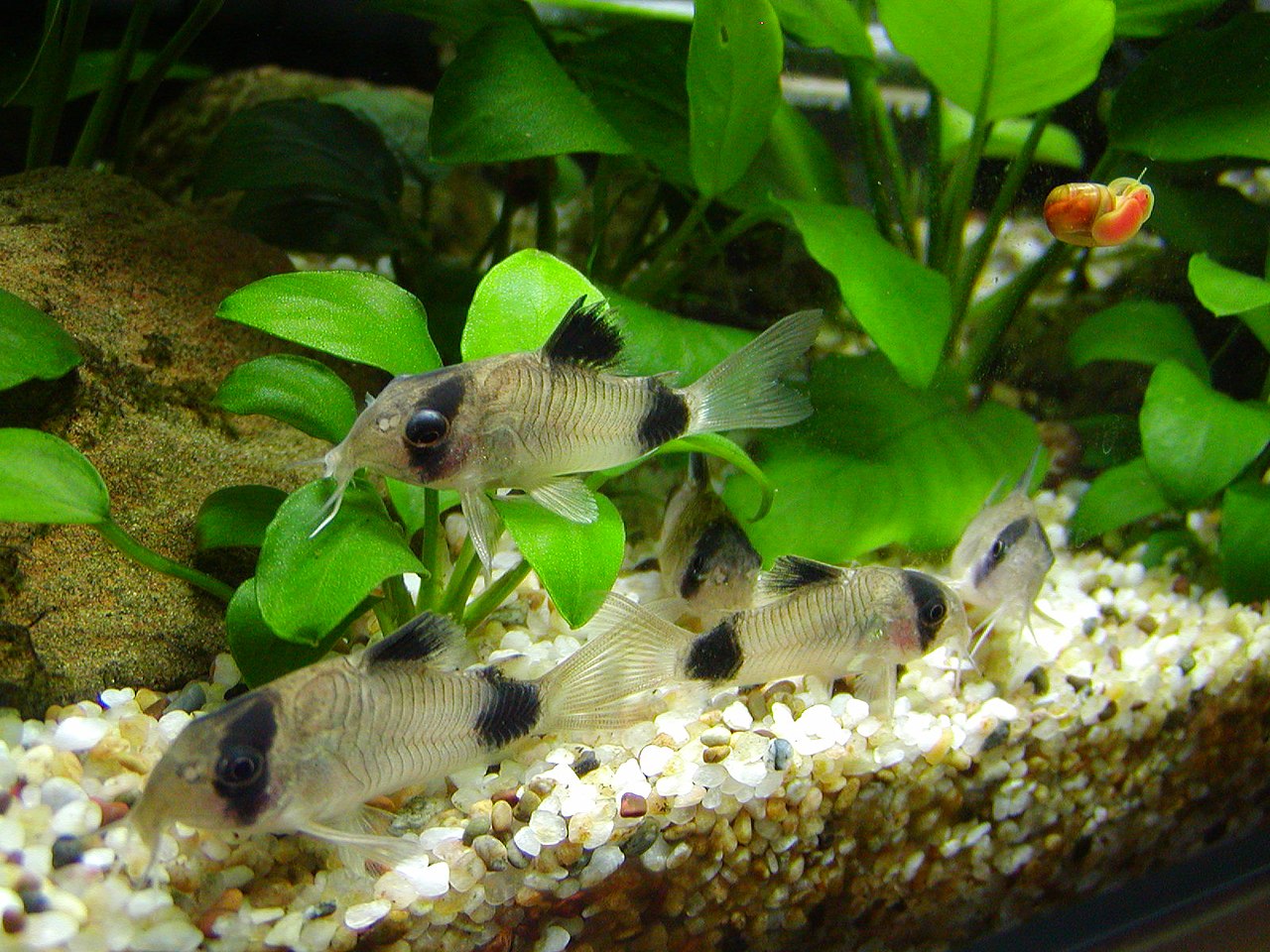
If ich appears in a tank with shrimp or plants, move only the fish to a separate container for treatment. For catfish such as corydoras, read the cautions in the medication's instructions carefully.
Some animals are more sensitive than fish to ich medication and salt. Here are the cautions in the sources, by animal.
| Animals in the tank | What to watch | How to treat |
|---|---|---|
| Shrimp, snails | Some invertebrates are sensitive to medication. Most invertebrates cannot tolerate medication containing copper | Move the fish to a separate container |
| Plants | May die from methylene blue. Also sensitive to salt | Move the fish to a separate container |
| Corydoras, plecos, kuhli loaches | Smooth-skinned fish tend to recover slowly. Some fish are sensitive to medication | Follow the cautions in the instructions and check on them often |
| Goldfish, medaka | Fish that need no heater. There is a limit to how far you can raise the temperature | Rely mainly on salt baths |

The University of Florida guide says to use half the dose of formalin for sensitive species. In a U.S. test, North American catfish were the fish most sensitive to formalin.
Even after the fish are moved, cyst-stage parasites remain in the main tank. The young parasites cannot multiply without fish.
A manual for veterinarians says leaving the tank without fish for a period prevents the disease from spreading again. Make that period longer than the cycle length in the table.
Leave the shrimp and plants in the main tank and treat only the fish in a separate container, and you protect both. Shrimp and fish compatibility is covered in Shrimp Tank Mates.
How do you treat ich in goldfish and medaka?
Ich in goldfish and medaka is also treated with salt baths and medicated baths. Neither needs a heater, so decide how far to raise the temperature from the upper limits in the table.
| Species | Temperature (°C) | Swimming level |
|---|---|---|
| Medaka | 16–22 | Top |
| Goldfish | 20–24 | Middle |
Source: Seriously Fish (Oryzias latipes) / RSPCA Australia: How should I care for my goldfish?
A manufacturer's guide says goldfish catch ich easily. Other diseases can also take hold once ich has weakened them.
The salt bath in the Osaka material uses ich in crucian carp (funa) as its example. Goldfish are relatives of the crucian carp.
As the table shows, medaka have a fairly low upper limit. Focusing on salt baths and medicated baths is easier than raising the temperature a lot.
Goldfish won at a festival scooping game (kingyo-sukui) are often weak. Watch them in a separate container before adding them to the tank.
For goldfish and medaka, think of curing ich with salt and medicated baths rather than heat, and you will not push them too hard. Partners for them are covered in Goldfish Tank Mates and Medaka Tank Mates.
How long does ich take to cure?
Medicated baths for ich take 1 to 2 weeks. Even after the white spots are gone, keep going for one full cycle of the parasite.
Here is how the sources think about how long to continue treatment.
| Water temperature | Treatment interval | Approximate number of treatments | Source |
|---|---|---|---|
| Around 24 to 26°C | Every day | At least 3 to 5 | University of Florida |
| About 16°C | Every 3 to 5 days | At least 5 | University of Florida |
| Above 26°C | Every day | Often 3 to 7 | A manual for veterinarians |
When you use a commercial medication, follow its instructions for the days and number of treatments. The table above is a guide to why treatment is repeated.
As the fish recover, the white grains look clear and then disappear. The University of Florida guide says to continue until no more fish are dying.
Do not end treatment on the day the white spots disappear. End it after watching through one more cycle.
Is ich contagious, and how do you stop it coming back?
Yes, ich is contagious. It can spread to the other fish in the same tank within a few days.
Here are the steps to stop it coming back, from the University of Florida and manufacturer sources.
- Keep new fish in a separate tank for at least 30 days and watch them
- Keep new plants and decorations somewhere without fish for one cycle before adding them
- Use separate nets and hoses for each tank, or disinfect them before use
- Keep the temperature steady and avoid sudden swings
- Keep watching fish that have recovered (they can go on carrying the parasite)
According to the University of Florida guide, ich can appear 1 to 3 weeks after fish are shipped. The stress of transport wakes up parasites that were hiding.
Match the temperature of water-change water to the tank. Cold water alone is enough to weaken fish.
The steps for welcoming new fish are in Acclimation. You prevent ich from coming back by not bringing it in and not letting the temperature swing.
What are common mistakes with ich?
The most common mistake is stopping after one dose of medication. Leaving activated carbon in and medicating a shrimp tank are also common.
| Common mistake | What happens | What to do instead |
|---|---|---|
| One dose and done | Young parasites come out of cysts on the bottom and it spreads again | Repeat with gaps in between |
| Stopping as soon as the white spots go | It comes back one cycle later | Continue for one full cycle |
| Leaving activated carbon in | It absorbs the medication, so the medication does not work | Remove it during treatment |
| Medicating a tank with shrimp or plants | The shrimp weaken and the plants die | Move the fish to a separate container |
| Raising the temperature all at once | Oxygen drops and the fish struggle | Raise it gradually and increase aeration |
| Guessing the amount of salt | The strength is off, which stresses the fish | Measure the water and calculate |
| Continuing ich medication for a look-alike disease | It drags on without improving | Rethink if there is no improvement after about three rounds |
Ich treatment fails less often when you keep to three things: repeat, measure, and keep sensitive animals away.
What terms come up when talking about ich?
| Term | Meaning |
|---|---|
| Ich (white spot disease) | A disease in which parasites attach to the skin or gills and white grains appear |
| Uonokaisenchu | The Japanese name for the parasite that causes ich in freshwater fish. Also called Ichthyophthirius |
| Life cycle | One round from the parasite attaching to a fish until it produces the next generation |
| Young parasites | Small parasites that swim out of the cyst. The stage when medication and salt work |
| Medicated bath | Treating fish by putting them in water with medication dissolved in it |
| Salt bath | Treating fish by putting them in water with salt dissolved in it |
| Activated carbon | A filter medium that absorbs dirt and color from water. It also absorbs medication |
| Invertebrates | Animals without a backbone, such as shrimp and snails |
| Quarantine tank | A tank where new fish are kept separately before they go into the main tank |
What else should you know along with ich?
Ich starts with temperature swings and parasites brought in from outside. Read about keeping the temperature steady and welcoming new fish too.
- Keeping the temperature steady: Tropical Fish Water Temperature
- Steps for adding new fish: Acclimation
- Shrimp and fish compatibility: Shrimp Tank Mates
- Compatibility for bottom dwellers that are sensitive to medication: Corydoras Tank Mates
 Care basicsTropical Fish Water Temperature: Chart for 23 Species, Setting It for Tank Mates, Heater Wattage, Summer Heat, Winter, Power Outages and How Goldfish and Medaka DifferTropical fish water temperature chart for 23 species. Setting it for tank mates, heater wattage by volume, thermometers, summer cooling, winter, outages and goldfish.
 Care basicsHow to Acclimate Fish: Matching Temperature and Water, Drip and Cup Method Steps and Timing, and Notes for Shrimp, Medaka and GoldfishHow to acclimate fish, step by step with times for temperature and water. Drip vs cup method, why shrimp need longer, why bag water stays out, medaka and goldfish.
 Shrimp and snailsWhich Fish Can Live with Shrimp? Neocaridina and Amano Ratings, Hiding Places, AcclimationShrimp tank mates rated ○△× with reasons for Neocaridina and Amano shrimp. Fish that eat baby shrimp vs adults, willow moss hiding places and acclimation steps.
 Tank mates by speciesCorydoras Tank Mates: 22 Species Rated ○△×, Shrimp, Crowded Bottoms and How Many to KeepCorydoras tank mates for 22 species, rated ○△× with reasons. Bettas, medaka and goldfish are ×. Shrimp, sharing the bottom with plecos, and how many to keep.
What are common questions about ich?
Does ich go away on its own?
Starting treatment early is safer than waiting. The University of Florida guide recommends treatment if even one parasite is found.
Ich multiplies quickly, so it can spread through the whole tank while you wait and see.
Does chili pepper (takanotsume) work for ich?
This site could not find any official source that has tested whether it works. We recommend starting with salt baths and medicated baths, which are backed by sources.
Choose treatments whose effect and dose are known.
Can ich spread from one tank to another?
It can spread through nets, hoses and splashes. The University of Florida guide recommends separate equipment for each tank.
Do not use the equipment from a tank under treatment on any other tank.
Should you change the water during ich treatment?
Yes. Change water before adding medication and siphon dirt off the bottom, and you also remove cyst-stage parasites.
The University of Florida guide says cleaning the bottom removes cysts. Match the new water's temperature to the tank.
Can you feed fish during ich treatment?
Feed lightly. Medication weakens the filter bacteria, so the water gets dirty more easily.
Give only as much as they finish, and remove any leftovers.
Is it the same disease as ich in saltwater fish?
No, it is a different parasite. Ich in marine fish is caused by a different parasite called Cryptocaryon.
Think about treatment and medication separately for freshwater and marine fish.
Sources
- UF/IFAS EDIS FA006: Ichthyophthirius multifiliis (White Spot) Infections in Fish (life cycle, up to 1,024 young parasites per cyst, temperature and cycle length, treatment interval and number of treatments, 4 to 5 g/L of salt for 7 to 10 days, plants are sensitive to salt, half dose for species sensitive to formalin, 30 days of quarantine, 1 to 3 weeks after shipping, separate equipment, treat even for one parasite)
- MSD Veterinary Manual: Parasitic Diseases of Fish (diagnosing ich, 5 g/L of salt for 1 week, daily above 26°C, a fish-free period prevents it spreading again, commercial formalin and malachite green products, velvet shows golden dots, marine fish have a different parasite)
- UF/IFAS EDIS FA165: Use of Copper in Marine Aquaculture and Aquarium Systems (most invertebrates cannot tolerate copper treatment)
- Research Institute of Environment, Agriculture and Fisheries, Osaka Prefecture: Disease name: white spot disease (病名 白点病, in Japanese. Symptoms, 1-hour bath in 1% salt water, temperature of about 25°C, breaks out most easily around 20°C)
- GEX: White spots on your goldfish! Causes and treatment of white spot disease (金魚の体に白い点が!白点病の原因や治療法, in Japanese. Triggers, rubbing, heating to 28 to 30°C, changing two-thirds of the water and medicated baths for 1 to 2 weeks, removing activated carbon, feeding less, goldfish catch it easily)
- Methylene blue solution for aquarium fish: instructions for use (観賞魚用メチレンブルー液 使用説明書, in Japanese. 2nd edition, June 2022. Uses, may kill plants, a filter reduces the effect, avoid light, do not mix with other medications)
- sera: Healthy aquarium fish (ich grains 0.4 to 1.5 mm, velvet under 0.3 mm, lymphocystis looks similar, invertebrates in a separate tank)
- ANGFA: Ichthyophthiriasis (Adrian R. Tappin, Rainbowfishes, 2011. Cycle length by temperature, dissolved oxygen drops by more than 17% from 20°C to 30°C, smooth-skinned fish recover slowly)
- Alaska Department of Fish and Game: Saprolegniasis (fungus looks like white or brown cotton)
- U.S. Fish and Wildlife Service: Investigations in Fish Control 73 Formalin: Its Toxicity to Nontarget Aquatic Organisms (of the fish tested, black bullhead and channel catfish were the most sensitive to formalin)