Tank-mate chartTM-01
Tropical Fish Tank Mates Chart: 23 Species Rated ○△× with Reasons, Safe Sets and Mistakes

Tropical fish tank mates depend on water temperature, size, fins and temperament, and whether a fish eats shrimp. We rate 23 species ○△× with reasons.

In this article (16 sections)
- In short: how do you choose tropical fish tank mates?
How do you read tropical fish tank mates from the quick charts?5
- In what order do you check tropical fish tank mates?
- How can you spot tropical fish whose temperatures do not match?
- How big a size gap is safe for tropical fish tank mates?
- How do fin nipping and temperament change tropical fish tank mates?
- What should you watch for with shrimp, snails and tropical fish?
- Does using different swimming levels make tank mates easier to choose?
- Which tropical fish care data should you compare?
What are some tropical fish tank mates where every pair is ○?4
- What are common mistakes with tropical fish that cannot live together?
- Once the set is chosen, what order and how many fish?
- What terms are used for tropical fish tank mates?
- What else goes with choosing tropical fish tank mates?
- Sources
In short: how do you choose tropical fish tank mates?
Choose tropical fish tank mates by four things: water temperature, size, fins and temperament, and whether a fish eats shrimp. If all four are fine, the fish are easy to keep together.
The usual advice is "pick peaceful fish of about the same size." That is a sound rule of thumb. But few guides say how far the temperature ranges overlap, or what to do about shrimp.
This site calculates compatibility with fixed rules from the care data of 23 species. Each answer is one of three levels: ○ (easy to keep together), △ (only with conditions) or × (not suitable). A reason comes with every answer.
What this article covers:
- The compatibility checker: pick 2 to 4 species and see ○△× and the reason for every pair
- Quick charts by group: small characins, guppies and platies, shrimp and snails, medium-sized fish, fish that need no heater
- The order of the checks, and the rules behind them
- Sets where every pair is ○, and common mistakes
- How to think about the order of adding fish and how many to keep
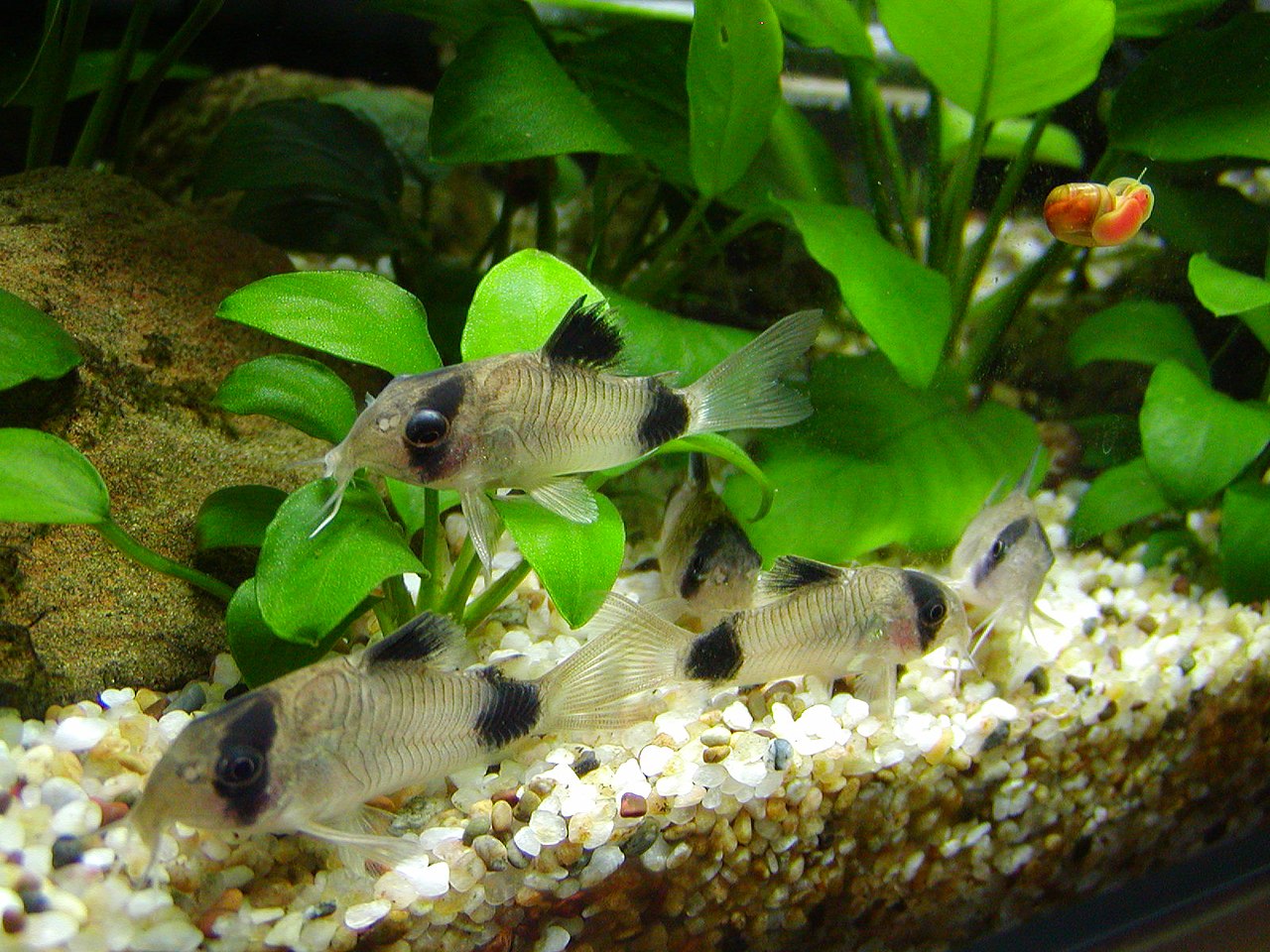
The checker opens with neon tetra, panda corydoras and Neocaridina shrimp selected. Swap a species and the results change right away.
Check tank mates for every pair of species you plan to keep. Three species make 3 pairs, and four species make 6 pairs. If even one pair is ×, rethink that tank.
How do you read tropical fish tank mates from the quick charts?
The fastest way is the quick charts, one for each group of fish that people often choose together. The cell where a row meets a column is the compatibility of those two species.
There are five charts. Start with the group you are interested in. To read the reason for a cell, pick the same two species in the checker above.
Can neon tetras and other small characins live with bottom dwellers?
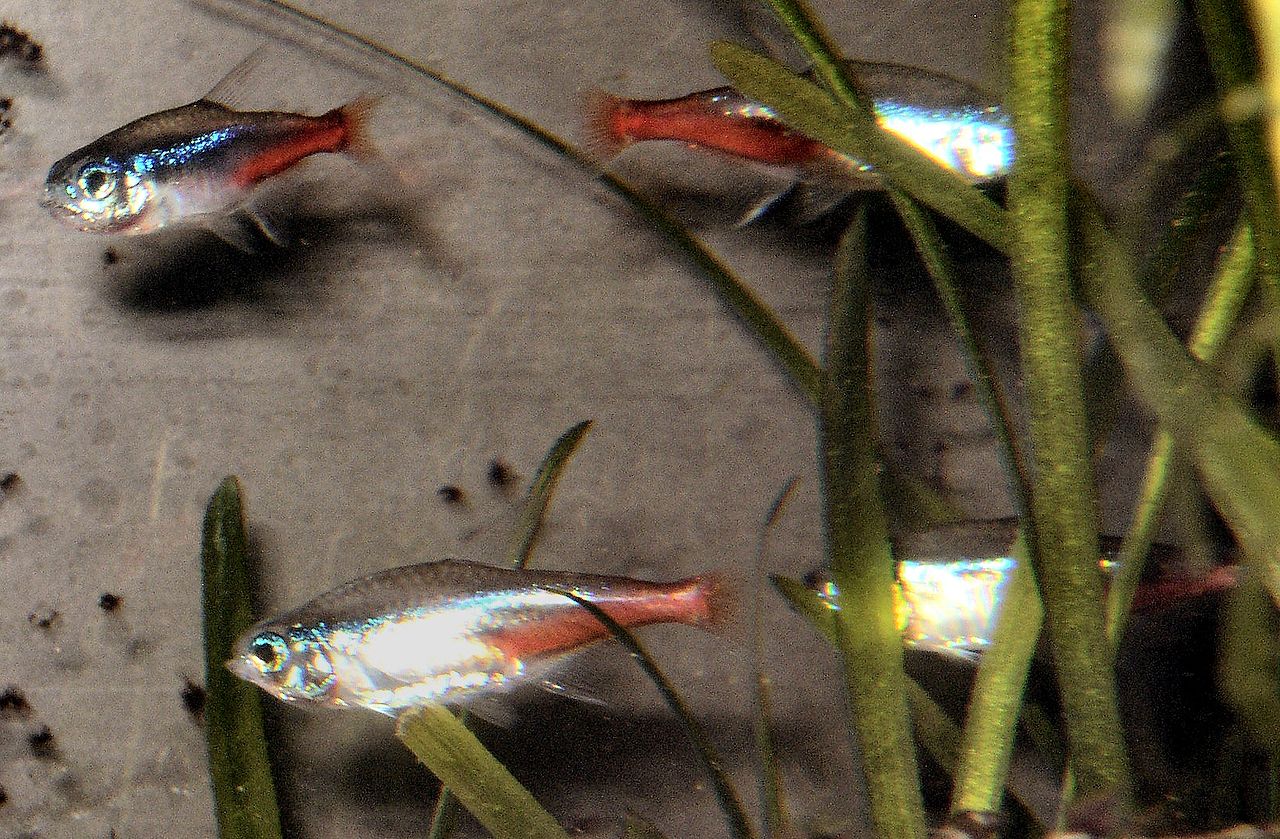
With these six species, every pair is ○. They like similar water temperature and water chemistry, and all of them are peaceful.
| 1 | 2 | 3 | 4 | 5 | 6 | |
|---|---|---|---|---|---|---|
| 1Neon tetra | · | ○ | ○ | ○ | ○ | ○ |
| 2Cardinal tetra | ○ | · | ○ | ○ | ○ | ○ |
| 3Rummy-nose tetra | ○ | ○ | · | ○ | ○ | ○ |
| 4Harlequin rasbora | ○ | ○ | ○ | · | ○ | ○ |
| 5Panda cory | ○ | ○ | ○ | ○ | · | ○ |
| 6Otocinclus | ○ | ○ | ○ | ○ | ○ | · |
○ Generally compatible △ With care × Not recommended
Source: Judged by this site's rules from the care data of each species (see the sources of the care data table)
Characins (small fish from South America, such as the neon tetra) swim in schools in the middle of the tank. Corydoras and otocinclus live on the bottom and on the glass.
Cardinal tetras like warmer water than neon tetras. The ranges still overlap enough, so the pair is ○ (the figures are in the care data table).
Can guppies and platies live with bettas or tiger barbs?
Guppies and platies are ○ with each other. Both are × with bettas, and guppies are × with tiger barbs.
| 1 | 2 | 3 | 4 | 5 | 6 | |
|---|---|---|---|---|---|---|
| 1Guppy | · | ○ | ○ | ○ | × | × |
| 2Platy | ○ | · | ○ | ○ | △ | × |
| 3Neon tetra | ○ | ○ | · | ○ | △ | × |
| 4Panda cory | ○ | ○ | ○ | · | △ | × |
| 5Tiger barb | × | △ | △ | △ | · | × |
| 6Betta (male) | × | × | × | × | × | · |
○ Generally compatible △ With care × Not recommended
Source: Judged by this site's rules from the care data of each species (see the sources of the care data table)
Guppies and platies are livebearers (fish whose eggs hatch inside the mother, so she gives birth to fry). Both are peaceful, and both are ○ with neon tetras and corydoras.
Every × here comes down to fins. Guppies have long fins, and tiger barbs nip the fins of other fish. A male betta sees long-finned fish as rivals and attacks them.
Tiger barbs also get a row of △ with partners other than guppies. This is because they sometimes nip fins.
How do shrimp and snails do with small fish?
Most pairs of shrimp or snails with small fish are ○. But fish that eat baby shrimp are △ with Neocaridina shrimp, and the kuhli loach is ×.
| 1 | 2 | 3 | 4 | 5 | 6 | |
|---|---|---|---|---|---|---|
| 1Japanese swamp shrimp | · | ○ | ○ | ○ | △ | × |
| 2Amano shrimp | ○ | · | ○ | ○ | ○ | ○ |
| 3Nerite snail | ○ | ○ | · | ○ | ○ | ○ |
| 4Neon tetra | ○ | ○ | ○ | · | ○ | ○ |
| 5Otocinclus | △ | ○ | ○ | ○ | · | ○ |
| 6Kuhli loach | × | ○ | ○ | ○ | ○ | · |
○ Generally compatible △ With care × Not recommended
Source: Judged by this site's rules from the care data of each species (see the sources of the care data table)
Neocaridina shrimp breed in the aquarium. Newborn baby shrimp are tiny, and even small fish like otocinclus can eat them.
Amano shrimp do not breed in the aquarium, because their larvae grow up in the sea. So there are no baby shrimp to worry about, and they are ○ with all six species.
Can angelfish or dwarf gouramis live with small fish?
Medium-sized fish can be ○ or × with small fish, depending on the pair. The angelfish is × with the neon tetra but ○ with the kuhli loach.
| 1 | 2 | 3 | 4 | 5 | 6 | |
|---|---|---|---|---|---|---|
| 1Angelfish | · | △ | × | × | △ | ○ |
| 2Dwarf gourami | △ | · | △ | ○ | ○ | ○ |
| 3Tiger barb | × | △ | · | △ | △ | △ |
| 4Neon tetra | × | ○ | △ | · | ○ | ○ |
| 5Panda cory | △ | ○ | △ | ○ | · | ○ |
| 6Kuhli loach | ○ | ○ | △ | ○ | ○ | · |
○ Generally compatible △ With care × Not recommended
Source: Judged by this site's rules from the care data of each species (see the sources of the care data table)
As it grows, the angelfish may eat small fish such as tetras. The kuhli loach, which stays on the bottom, is said to be a good partner.
The dwarf gourami is ○ with neon tetras, corydoras and kuhli loaches. The tiger barb is not ○ with any partner in this chart.

How do fish that need no heater do together?
Medaka are ○ with Neocaridina shrimp, Amano shrimp and nerite snails. Goldfish are × with shrimp, and medaka with goldfish is △.
| 1 | 2 | 3 | 4 | 5 | 6 | |
|---|---|---|---|---|---|---|
| 1Medaka | · | △ | ○ | ○ | ○ | △ |
| 2Goldfish | △ | · | × | × | ○ | △ |
| 3Japanese swamp shrimp | ○ | × | · | ○ | ○ | △ |
| 4Amano shrimp | ○ | × | ○ | · | ○ | ○ |
| 5Nerite snail | ○ | ○ | ○ | ○ | · | ○ |
| 6Zebra danio | △ | △ | △ | ○ | ○ | · |
○ Generally compatible △ With care × Not recommended
Source: Judged by this site's rules from the care data of each species (see the sources of the care data table)
Medaka and goldfish can spend the winter outdoors in Japan. Paired with tropical fish that need a heater, one of the two is under strain, so the result is △ or worse.
This site treats the zebra danio as a fish that needs a heater. That is why it is △ with medaka and with goldfish.
The zebra danio is also △ with Neocaridina shrimp. It may not eat adult shrimp, but it can steal their food and chase them.
If a set has a × cell in the quick chart, rethink it even if every other cell is ○. Compatibility is decided by the worst pair.
In what order do you check tropical fish tank mates?
Check tropical fish tank mates in this order: water temperature, size, fins and temperament, then shrimp. When there are several reasons, the worst level is the answer.
This site decides ○△× with the rules below. The figures come from the care data, and the thresholds (the numbers where the answer changes) are as shown in this table.
| What to check | × (not suitable) | △ (with conditions) |
|---|---|---|
| Water temperature | The suitable ranges overlap by less than 1°C (including ranges that only touch at the ends) | Overlap of less than 2°C |
| Water chemistry (pH) | None | The preferred pH ranges do not overlap |
| Heater needed or not | None | One fish needs a heater and the other does not |
| Size | A fish that eats small fish, with a fish half its size or smaller | A size gap of 3 times or more (not applied if the larger fish is a peaceful species) |
| Shrimp | A fish that eats shrimp, with shrimp | A fish that eats baby shrimp, with shrimp (except Amano shrimp) |
| Fin nipping | A fin nipper, with a long-finned fish | A fin nipper, with any other fish |
| Temperament | An aggressive fish, with any other fish | A somewhat aggressive fish, with a long-finned fish |
The "3 times" for size is this site's own guideline, not a figure from the sources. If none of the levels applies, the pair is ○.
Some pairs cannot be settled by the rules alone. Only for pairs we checked in published sources, the rule's answer is replaced with a case-by-case judgment.
For example, medaka and Neocaridina shrimp would be × under the temperature rule. A manufacturer's guide says they are well suited to each other, so we mark them ○.
○△× is decided by the worst of the reasons. Three △ reasons still make △, and a single × makes ×.
How can you spot tropical fish whose temperatures do not match?
Look at how much the suitable temperature ranges of the two species overlap. Less than 1°C of overlap is ×, and less than 2°C is △.
Each species has a range of suitable temperatures. Line up the two ranges and see whether some temperature falls inside both. The figures are in the care data table.
| Pair | Compatibility | How the temperatures look |
|---|---|---|
| Neon tetra × cardinal tetra | ○ | The ranges overlap enough |
| Medaka × neon tetra | △ | The overlap is narrow, and only one needs a heater |
| Medaka × cardinal tetra | × | The suitable ranges do not overlap |
| Medaka × panda corydoras | × | The suitable ranges do not overlap |
| Dwarf gourami × medaka | × | The suitable ranges do not overlap |
When the preferred water chemistry (pH) does not overlap, we mark the pair △. Water chemistry can be adjusted to some degree, so we do not mark it ×. Among the current 23 species, no pair is △ because of pH alone.
Fish that differ in whether they need a heater are also △. Even if the temperatures overlap, setting the tank for the tropical fish makes it on the warm side for the other.
Set the heater inside the range where the two species' suitable temperatures overlap. Near either end, the water is too warm or too cold for one of them.
For temperature, look not only at whether the ranges overlap but at how much. A pair with a narrow overlap can easily drift out of range as the room temperature changes with the seasons.
How big a size gap is safe for tropical fish tank mates?
A fish that eats small fish, kept with a fish half its size or smaller, is ×. A size gap of 3 times or more is also marked △.
In this site's data, the fish confirmed by sources to eat small fish are the angelfish and the goldfish.
- Angelfish: Seriously Fish says it "may eat small fish such as tetras"
- Goldfish: RSPCA Australia says it can live with many tropical fish if the other fish is "larger than the goldfish's mouth"
The △ for a 3-times gap is not applied when the larger fish is a peaceful species. This keeps fish like the plant-eating bristlenose pleco from being marked △. Among the current 23 species, no pair is △ for this reason alone.
Size is compared using the "adult size" in the care data. In the shop, most fish are still small.
The angelfish also grows tall as an adult. Seriously Fish recommends a tank at least 50 cm high for adults.
Compare sizes as adults, not as they are when you buy them. Fish of the same size today can be far enough apart in six months that one fits in the other's mouth.
How do fin nipping and temperament change tropical fish tank mates?
A fin nipper with a long-finned fish is ×. An aggressive fish is × with every other fish.
In the care data, the traits related to fins and temperament are given to the species below. Each one was confirmed in a source.
| Trait | Species | Compatibility with others |
|---|---|---|
| Fin nipper | Tiger barb | × with long-finned fish, △ with other fish |
| Long fins | Guppy, betta (male), angelfish | × with fin nippers, △ with somewhat aggressive fish |
| Aggressive | Betta (male) | × with every other fish |
| Somewhat aggressive | Angelfish, tiger barb, dwarf gourami | △ with long-finned fish |
According to Seriously Fish, fin nipping by tiger barbs stands out when they are kept in small numbers. The same happens in a cramped tank. Keeping at least the group size in the table is a must.
For the male betta, Seriously Fish says it is "best kept alone." It may see long-finned fish as rivals and attack them.

If the edges of fins look white and ragged, suspect fin nipping. The simplest fix is never to put fin nippers and long-finned fish in the same tank.
Fin length and temperament can make a pair × even when the fish are the same size. This is where "they are both small, so it is fine" does not always hold.
What should you watch for with shrimp, snails and tropical fish?
Shrimp are × with fish that eat shrimp, and △ with fish that eat baby shrimp. The nerite snail is ○ with every one of the 23 species.
These are the fish confirmed by sources to eat shrimp or baby shrimp.
| Trait | Species | Compatibility with shrimp |
|---|---|---|
| Eats shrimp | Angelfish, goldfish | × |
| Eats baby shrimp | Guppy, betta (male), otocinclus, kuhli loach | △ (Neocaridina shrimp and red cherry shrimp) |
Even with fish that eat baby shrimp, adult shrimp usually survive, so we mark these pairs △. Amano shrimp have no baby shrimp in the aquarium, so this rule does not apply to them.
The kuhli loach is × with Neocaridina shrimp and red cherry shrimp, as a case-by-case judgment. A specialist shop's guide says it often eats baby shrimp, so it is best avoided.

If you keep shrimp with fish, grow plants thickly to make hiding places. When baby shrimp can escape, more of them survive.
For shrimp and fish pairs by shrimp species, see Fish That Can Live with Shrimp.
Think about adult shrimp and baby shrimp separately. If you want the shrimp to breed, avoid the △ fish. If you do not, you can keep them even with △ fish.
Does using different swimming levels make tank mates easier to choose?
When fish use different levels of the tank, they get in each other's way less, even in the same tank. Use this as a guide when choosing among pairs that are already ○.
A common tip is to choose fish for the top, middle and bottom levels. A guide from the German maker sera also puts guppies at the top and neon tetras in the middle.
For example: guppies (top), neon tetras (middle) and panda corydoras (bottom). Every pair of the three is ○. The levels are split, and the whole tank looks used.
But this site's ○△× calculation does not include swimming levels. Even at different levels, the tiger barb (middle) and the guppy (top) stay ×.
We found no source giving the swimming level of the betta or the angelfish. They are left blank in the table.
Swimming level is a guide for choosing among ○ pairs. Living at different levels is never a reason to turn × into ○.
Which tropical fish care data should you compare?
| Species | Adult size (cm) | Temperature (°C) | pH | Swimming level | Temperament | Group size (or more) |
|---|---|---|---|---|---|---|
| Neon tetra | 4 | 21–25 | 4–7.5 | Middle | Peaceful | 8 |
| Cardinal tetra | 3.5 | 23–29 | 3.5–7.5 | Middle | Peaceful | 8 |
| Rummy-nose tetra | 5 | 23–26 | 5.5–7 | Middle | Peaceful | 10 |
| Guppy | 6 | 17–28 | 7–8.5 | Top | Peaceful | 3 |
| Platy | 6 | 20–26 | 7–8.2 | Top | Peaceful | 3 |
| Betta (male) | 6.5 | 22–30 | 6–8 | Aggressive | 1 | |
| Angelfish | 15 | 24–30 | 6–7.4 | Semi-aggressive | 5 | |
| Panda cory | 5 | 22–25 | 6–7.4 | Bottom | Peaceful | 6 |
| Peppered cory | 7 | 22–26 | 6–7 | Bottom | Peaceful | 5 |
| Otocinclus | 3.5 | 21–26 | 5.5–7.5 | Bottom | Peaceful | 6 |
| Harlequin rasbora | 5 | 21–28 | 5–7.5 | Middle | Peaceful | 8 |
| Zebra danio | 5 | 18–25 | 6–8 | Middle | Peaceful | 8 |
| Cherry barb | 5 | 20–27 | 6–8 | Middle | Peaceful | 6 |
| Tiger barb | 7 | 20–26 | 5–8 | Middle | Semi-aggressive | 8 |
| Dwarf gourami | 9.5 | 22–27 | 6–7.5 | Middle | Semi-aggressive | 1 |
| Kuhli loach | 10 | 21–26 | 3.5–7 | Bottom | Peaceful | 5 |
| Bristlenose pleco | 12.5 | 21–26 | 5.5–7.5 | Bottom | Peaceful | 1 |
| Medaka | 4 | 16–22 | 6.5–8.5 | Top | Peaceful | 8 |
| Goldfish | 10 | 20–24 | 6.5–7.5 | Middle | Peaceful | 2 |
| Japanese swamp shrimp | 2.8 | 23–28 | 6.5–7 | Bottom | Peaceful | |
| Cherry shrimp | 4 | 16–28 | 6.5–8.5 | Bottom | ||
| Amano shrimp | 4 | 20–28 | 6.5–7.5 | Bottom | ||
| Nerite snail | 2 | 10–28 | 7 | Peaceful |
Source (23)
- Seriously Fish (Paracheirodon innesi)
- Seriously Fish (Paracheirodon axelrodi)
- Seriously Fish (Hemigrammus bleheri)
- Seriously Fish (Poecilia reticulata)
- Seriously Fish (Xiphophorus maculatus)
- Seriously Fish (Betta splendens)
- Seriously Fish (Pterophyllum scalare)
- Seriously Fish (Corydoras panda)
- Seriously Fish (Corydoras paleatus)
- Seriously Fish (Otocinclus macrospilus)
- Seriously Fish (Trigonostigma heteromorpha)
- Seriously Fish (Danio rerio)
- Seriously Fish (Puntius titteya)
- Seriously Fish (Puntigrus tetrazona)
- Seriously Fish (Trichogaster lalius)
- Seriously Fish (Pangio semicincta)
- Seriously Fish (Ancistrus cf. cirrhosus)
- Seriously Fish (Oryzias latipes)
- RSPCA Australia: How should I care for my goldfish?
- GEX (temperature), Tokyo Aqua Garden (pH, level, temperament), Kyoto Prefecture Red Data Book 2015 (size)
- Aquarium Co-Op (temperature, pH), UF/IFAS EDIS IN1301 (size, habitat)
- GEX (temperature), Tokyo Aqua Garden (pH, level), Hyogo Prefecture Red Data Book (size)
- Tokyo Aqua Garden (temperature, pH, temperament), Ishikawa Prefecture Red Data Book (size)
The values that decide tropical fish tank mates are collected in this table. Every compatibility result is calculated from these values.
- Temperature and pH: for fish, the values from Seriously Fish (a resource written for fishkeepers). Goldfish come from RSPCA Australia, and shrimp and snails from manufacturers and specialist shops
- Adult size: a guide to the largest size as an adult. Depending on the source, it is total length or body length
- Group size: the "at least this many" figure from the sources. Shrimp and snails have no figure, so the cell is blank
This table is the single reference for all figures. When the text says "as in the table," it means this table.
What are some tropical fish tank mates where every pair is ○?
Here are four sets where every pair is ○. We calculated every pair of species in each set and confirmed that all are ○.
| Set | Species | Good for |
|---|---|---|
| 1 | Neon tetra, harlequin rasbora, panda corydoras, Amano shrimp, nerite snail | A planted tank with a school and bottom dwellers |
| 2 | Guppy, platy, panda corydoras, bristlenose pleco, Amano shrimp | A tank built around colorful livebearers |
| 3 | Dwarf gourami, harlequin rasbora, peppered corydoras, otocinclus, kuhli loach | A tank with one eye-catching centerpiece fish |
| 4 | Medaka, Neocaridina shrimp, Amano shrimp, nerite snail | A tank with no heater |
You do not need every species in a set. If you remove species from a set where every pair is ○, the rest stay ○.
What if neon tetras and corydoras are the core?
Use set 1 as it is. Neon tetras and harlequin rasboras take the middle, corydoras the bottom, and the shrimp and snails eat algae and leftover food.
Seriously Fish says neon tetras settle better when other schooling fish are present. Keeping two schooling species follows that idea.

What if guppies or platies are the core?
Use set 2. Guppies and platies stay near the top, and corydoras and the bristlenose pleco live on the bottom.
The bristlenose pleco is peaceful toward other species. According to Seriously Fish, it fights over territory with its own kind and with similar-looking fish. Keeping just one pleco is the safe choice.

What if the dwarf gourami is the centerpiece?
Use set 3. It pairs the dwarf gourami with a peaceful school and bottom dwellers.
Seriously Fish names small cyprinids such as the harlequin rasbora as good partners. Corydoras are named too.
It also says that in a small tank, the dwarf gourami should be treated as the centerpiece. Keeping two males is asking for trouble unless the tank is large.
What if you want no heater?
Use set 4. Every pair of medaka, shrimp and snails in it is ○.
Under the temperature rule alone, medaka and Neocaridina shrimp would be ×. We mark them ○ as a case-by-case judgment, because the manufacturer GEX says they are well suited to living with medaka.
Once you have a set where every pair is ○, check again with the checker each time you add a species. The new species makes new pairs with every species already in the tank.
What are common mistakes with tropical fish that cannot live together?
Common mistakes are bettas with small fish, angelfish with neon tetras, and guppies with tiger barbs. All are ×, and the reasons are clear.
| Pair | Compatibility | Reason | Alternative (○) |
|---|---|---|---|
| Betta (male) × neon tetra | × | The betta is aggressive and chases other fish | For a betta, a nerite snail |
| Betta (male) × guppy | × | The betta sees long-finned fish as rivals and attacks them | For guppies, platies or corydoras |
| Angelfish × neon tetra | × | A grown angelfish may eat small fish | For an angelfish, kuhli loaches or a bristlenose pleco |
| Guppy × tiger barb | × | Tiger barbs nip the guppy's long fins | For tiger barbs, zebra danios |
| Medaka × panda corydoras | × | The suitable temperatures do not overlap, and only one needs a heater | For medaka, Neocaridina shrimp or nerite snails |
| Goldfish × neon tetra | × | A neon tetra is small enough to fit in a goldfish's mouth | For goldfish, nerite snails |
| Kuhli loach × Neocaridina shrimp | × | The loach often eats baby shrimp | For kuhli loaches, Amano shrimp |
Most mistakes are pairs added on the thought "it is small and peaceful, so it will be fine." Bettas and angelfish both look small and calm in the shop.
If you have already started with a × pair, act in this order.
- Check for fish that are being chased or have damaged fins
- Separate them into another tank, or with a divider inside the tank
- Set the temperature and water chemistry of the new space to suit that fish
- Ask the shop where you bought the fish whether they can take it back or exchange it
If you see chasing or fin damage, separate the fish without waiting for them to get used to each other. The reasons behind a × do not go away with time.
Once the set is chosen, what order and how many fish?
For order, the sources support adding shy fish such as otocinclus later, into a tank that has settled. For numbers, keep schooling fish at or above their group size.
Here is what the sources we checked say, by situation.
| Situation or species | What the source says | Source |
|---|---|---|
| A tank you are cycling (a new tank) | For the first 6 weeks, test ammonia and nitrite every 2 to 3 days | RSPCA Australia |
| Otocinclus | Fewer problems when added to a settled, planted tank | Seriously Fish |
| Tiger barb | Fin nipping stands out when numbers are too low or the tank is too small | Seriously Fish |
| Dwarf gourami | A male and female pair is best. Two males are asking for trouble | Seriously Fish |
| Angelfish | Squabbles among their own kind. Keep a small group | Seriously Fish |
| Corydoras | Much calmer and more active with their own kind | Seriously Fish |
| Total number of fish | The more fish, the bigger the tank needed | RSPCA Australia |
According to Seriously Fish, otocinclus lose their food to active fish. It works better to let the tank settle first, with plants and algae, and then add them.
We found no primary source that sets how many species a tank can hold. The sure way is to check each new species against every species already in the tank with the checker.
Bring schooling fish up to their group size before you enjoy them. Some fish, like corydoras, are calmer and move more freely with more of their own kind.
Reaching the group size comes first. Adding more species comes later. The more species you add, the harder it is to keep enough of each.
What terms are used for tropical fish tank mates?
| Term | Meaning |
|---|---|
| Tank mates (混泳) | Keeping different kinds of fish or shrimp in the same tank |
| Suitable temperature (適温) | The range of water temperature in which a fish stays healthy |
| pH | How acidic or alkaline the water is. 7 is neutral, and lower numbers are more acidic |
| Characin (カラシン) | A group of small fish from South America and Africa, such as the neon tetra |
| Livebearer (卵胎生) | A fish whose eggs hatch inside the mother, so she gives birth to fry. Guppies and platies |
| Bottom dweller (底もの) | A fish that lives on the bottom of the tank, such as corydoras and plecos |
| Fin nipping (ヒレかじり) | A habit of biting other fish's fins. The tiger barb is well known for it |
| Baby shrimp (稚エビ) | Newborn, very small shrimp. Even small fish eat them |
| Cycling a new tank (立ち上げ) | The period from filling a new tank with water until fish can live in it |
What else goes with choosing tropical fish tank mates?
If you already know your main fish, see its own article for compatibility with every species.
- Fish that can live with neon tetras: Neon Tetra Tank Mates
- Animals that can live with bettas: Betta Tank Mates
- Fish that can live with guppies: Guppy Tank Mates
- Fish that can live with corydoras: Corydoras Tank Mates
- Fish that can live with shrimp: Fish That Can Live with Shrimp
 Tank mates by speciesNeon Tetra Tank Mates: 22 Species Rated ○△× with Reasons, plus Medaka, Shrimp, CardinalsNeon tetra tank mates for 22 species, rated ○△× with reasons. Bettas, angelfish and goldfish are ×. Medaka, tiger barbs, shrimp and cardinals, with sources.
 Tank mates by speciesCan Bettas Have Tank Mates? Why Males Live Alone, plus Cherry Barbs, Shrimp, SnailsA male betta is best kept alone. Betta tank mates for 22 species rated ○△× with reasons, the cherry barb, shrimp and snail exceptions, and fixes if it fails.
 Tank mates by speciesGuppy Tank Mates: Good and Bad Partners, plus Shrimp, Fry and Keeping Guppies with PlatiesGuppies are ○ with most small, peaceful fish. Guppy tank mates for 22 species rated ○△× with reasons, fin nippers, platies, shrimp, medaka, fry and tank size.
 Tank mates by speciesCorydoras Tank Mates: 22 Species Rated ○△×, Shrimp, Crowded Bottoms and How Many to KeepCorydoras tank mates for 22 species, rated ○△× with reasons. Bettas, medaka and goldfish are ×. Shrimp, sharing the bottom with plecos, and how many to keep.
 Shrimp and snailsWhich Fish Can Live with Shrimp? Neocaridina and Amano Ratings, Hiding Places, AcclimationShrimp tank mates rated ○△× with reasons for Neocaridina and Amano shrimp. Fish that eat baby shrimp vs adults, willow moss hiding places and acclimation steps.
Frequently asked questions about tropical fish tank mates
Can tetras and guppies live together?
Neon tetras and guppies are ○. Their temperatures overlap, and both are peaceful.
Guppies like water from neutral up, and neon tetras like water from neutral down. Their preferences meet around neutral (as in the table). Cardinal tetras and rummy-nose tetras are also ○ with guppies.
What fish can go in with neon tetras?
Neon tetras are ○ with most of the 23 species. They are × with the betta (male), angelfish and goldfish, and △ with tiger barbs and medaka.
Neon Tetra Tank Mates lists every partner. Small characins, corydoras, shrimp and snails are almost all ○.
Can a betta live with other fish?
In this site's calculation, the betta (male) is × with almost every other fish. Only the cherry barb is △.
Among shrimp and snails, the nerite snail is ○, and Amano shrimp, Neocaridina shrimp and red cherry shrimp are △.
The sources favor making a single betta the star rather than adding fish. See Betta Tank Mates for details.
What animals can live with tropical fish?
Shrimp and snails. The nerite snail is ○ with every one of the 23 species.
For shrimp, the answer depends on the species. Amano shrimp are ○ with many fish, while Neocaridina shrimp are △ with fish that eat baby shrimp. Angelfish and goldfish are × with every shrimp.
Can medaka live with tropical fish?
Medaka with tropical fish are △ or ×. Medaka need no heater, so their suitable temperature is off from that of tropical fish.
They are △ with neon tetras, guppies, platies and zebra danios, and × with cardinal tetras and corydoras. Good ○ partners for medaka are Neocaridina shrimp, Amano shrimp and nerite snails.
How should you feed a community tank?
Each time, check that food reaches the bottom dwellers and the shy fish. Active fish can eat it all first.
Seriously Fish says otocinclus lose their food to active fish. It also says the dwarf gourami does not suit partners that compete for food.
Shrimp live on the bottom, so use food that sinks and reaches them.
Sources
- Seriously Fish: Paracheirodon innesi (neon tetra. Schools, and settles better with other schooling fish)
- Seriously Fish: Pterophyllum scalare (angelfish. May eat small fish, squabbles among its own kind, tank height)
- Seriously Fish: Puntigrus tetrazona (tiger barb. Fin nipping, group size and tank space)
- Seriously Fish: Trichogaster lalius (dwarf gourami. Keep as a pair, two males, centerpiece, good and poor partners)
- Seriously Fish: Betta splendens (betta. Best kept alone, sees long-finned fish as rivals)
- Seriously Fish: Otocinclus macrospilus (otocinclus. Add to a settled tank, loses food to other fish)
- Seriously Fish: Corydoras panda (panda corydoras. Settles better with its own kind)
- Seriously Fish: Ancistrus cf. cirrhosus (bristlenose pleco. Territorial with its own kind and similar-looking fish)
- RSPCA Australia: How should I care for my goldfish? (fish larger than a goldfish's mouth, water testing for 6 weeks after setup, number of fish and tank size)
- sera: Fish stock for a 60 cm aquarium (guppies at the top level, neon tetras in the middle)
- GEX: How to keep Neocaridina shrimp (ミナミヌマエビの飼い方, in Japanese. Well suited to living with medaka)
- Tokyo Aqua Garden: Kuhli loach (クーリーローチ, in Japanese. Often eats baby shrimp)
- Aquarium Co-Op: Cherry Shrimp Tank Mates (hiding places for baby shrimp, fish that eat baby shrimp)
- The source for each row of care data (temperature, pH, size, swimming level, temperament, group size) is listed under the table "Fish, shrimp and snail care data"